





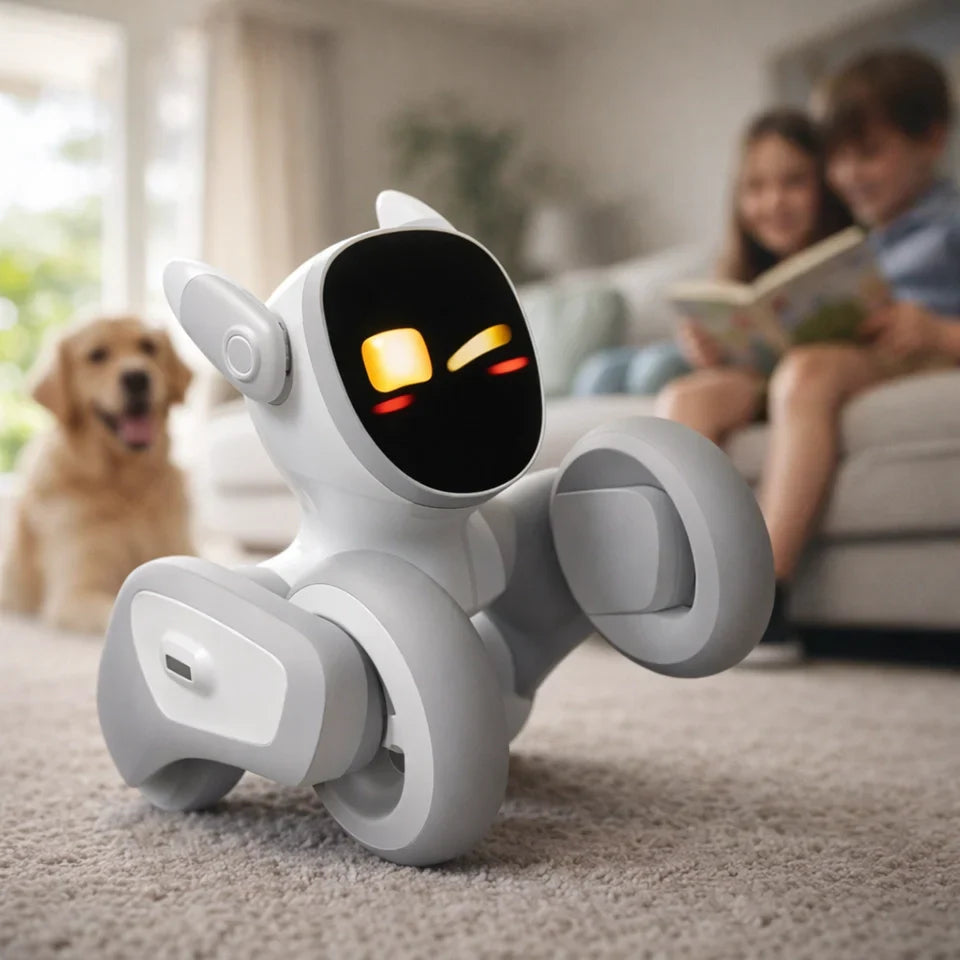
Best AI Robot in 2026: How to Choose the Right Smart Robot for Your Home
January 19, 2026
A few years ago, “robot” usually meant a vacuum that bumped into furniture, or a gadget that looked cute but mostly sat on a shelf. In 2026, the conversation is different. People searching “best AI robot” typically want something that feels alive in the right ways: a robot that can understand you, navigate your home, and be genuinely useful without becoming complicated, intrusive, or fragile.
For many American households, the motivation is practical: busy schedules, work-from-home life, and the desire for easier routines. For others, it’s emotional: a companion for kids, a playful presence for pet owners, or a friendly helper that makes the home feel more connected. And for buyers, there’s one big question behind the keyword: Which AI robot is actually worth the money—and won’t disappoint after the first week?
This guide breaks down what “best” really means, what capabilities matter most in real homes, and how to choose based on your life—not hype.
What Counts as the “Best” AI Robot Today?
“Best” is not a single model that wins for everyone. The best AI robot is the one that fits your home, your comfort level, and your daily needs while staying reliable over time. Most shoppers will be happiest with a robot that does three things well:
Understands what’s happening (voice, vision, sensors, context)
Acts usefully and predictably (movement, routines, safe autonomy)
Earns trust (privacy controls, updates, support)
In other words, a “best AI robot” isn’t just smart—it’s consistently helpful, easy to live with, and designed around real people. Use the sections below to translate marketing claims into practical buying criteria.
AI Brain vs. Robot Body: Autonomy, Sensing, and Movement
Think of an AI robot as two systems working together: the “brain” (software and intelligence) and the “body” (hardware that senses and moves). A great brain with a weak body leads to frustration—like a robot that talks well but can’t navigate your hallway. A strong body with a weak brain feels like a remote-controlled toy.
In a home setting, pay attention to:
Autonomy level: Does it do useful things without constant commands?
Sensing: Cameras, depth sensors, microphones—do they work in normal lighting and typical home noise?
Movement reliability: Does it move smoothly, avoid obstacles, and recover if something changes?
The best AI robots balance intelligence with physical capability so they can operate naturally in your space.
Useful Skills That Matter at Home: Patrol, Follow, Play, Remind, Assist
Most people don’t need a robot that performs a “wow” demo—they need a robot that shows up in daily life. The best home AI robots tend to shine in a few practical skill buckets:
Follow and interact: Moving with you room-to-room, responding quickly
Play and engage: Games, reactions, personality, family entertainment
Gentle reminders: Simple routines—“time for homework,” “walk the dog,” “medicine check”
Light assistance: Basic monitoring, check-ins, and “where is everyone?” peace of mind
If you’re buying for a family, usefulness often looks like small moments repeated daily, not one big heroic task.
Safety & Privacy Baseline: Cameras, Data Storage, Permissions
A home robot is more personal than most devices: it can see your home layout, hear conversations, and move near kids and pets. That means the “best” robot must meet a baseline that goes beyond features:
Clear privacy controls: Easy toggles, not hidden settings
Data transparency: What’s stored, what’s sent to the cloud, what stays local
Permission-based access: Family members can control what the robot can do and when
If a robot is impressive but makes you uneasy, it’s not the best—because you won’t use it long-term.
The Fast Checklist to Pick the Best AI Robot for Your Life
If you want a quick way to narrow options, start here. Most buyers can make a strong decision by matching the robot category to their primary goal—and then checking a few non-negotiables: reliability, privacy, and support.
Use this checklist as your fast filter before you compare specs.
If You Want a Family Companion Robot
Choose a robot that prioritizes:
Natural, friendly interaction (voice + expressive reactions)
Fun, repeatable activities for kids and adults
Safe movement and predictable behavior
If your goal is companionship and family engagement, consider a home AI companion like Loona—it’s designed around interaction, personality, and everyday fun. You can see Loona Robot when you’re ready to compare.
If You Want a Practical Helper Robot
Look for:
Strong navigation and obstacle avoidance
Routines that can run without babysitting
Clear app controls and dependable updates
Practical helper robots should reduce effort, not become another device you manage.
If You Want a Learning / STEM Robot for Kids
Prioritize:
Age-appropriate learning experiences
Safe design (materials + movement)
Content and updates that grow over time
The best “STEM” option is usually the one your child actually wants to use after the first day.
The Main Categories of AI Robots Americans Actually Buy
Before comparing “best” robots, it helps to understand what category you’re shopping in. Most household buyers fall into one of three groups, and each group values different strengths.
Home Companion Robots (Social + Emotional Interaction)
These robots focus on personality, interaction, and family presence. Their value is in:
Engagement (talking, reacting, playing)
A sense of companionship (especially for kids and pet owners)
Daily entertainment and “smart pet” vibes
If you’re buying for joy, bonding, and routine interaction, this is the category that usually delivers the most satisfaction.
Smart Security / Patrol Robots (Monitoring + Alerts)
This category is about awareness and peace of mind:
Check-ins when you’re away
Simple patrol routines
Notifications and alerts that don’t overwhelm you
The best options here are the ones that are reliable and respectful—useful signals, not constant noise.
Delivery, Logistics, and Business-Service Robots (Why You’ll See Them More)
You’ll increasingly see robots in hotels, hospitals, and warehouses. They’re optimized for:
Repeating tasks in controlled environments
Efficiency and uptime
Fleet management and predictability
These aren’t usually the best fit for a home—but they explain why “robots everywhere” is becoming normal.
The Most Advanced AI Robot Capabilities to Look For in 2026
The most meaningful improvements in 2026 aren’t about robots lifting heavy things in your kitchen. The real leap is that robots are getting better at understanding messy real life: clutter, background noise, shifting routines, and people who don’t want to learn complicated controls.
Here are the advanced capabilities that translate into a better home experience.
Natural Conversation That Feels Real (Context, Memory, Tone)
“Talks to you” is easy. “Understands you” is harder.
The best AI robots don’t just respond—they handle:
Context: Following a conversation without you repeating yourself
Tone: Sounding friendly without being overly robotic or overly human
Practical memory: Remembering preferences in a controlled way (and letting you reset it)
A good test: ask the robot two-step questions, like “What should we do after dinner?” and then “Okay, remind me in 30 minutes.” If it keeps the thread naturally, that’s a strong sign.
Vision That Understands Your Home (People, Pets, Obstacles, Rooms)
Home robots live in complex spaces: toys on the floor, moving pets, dim hallways, and furniture that changes. Advanced vision and sensing should help the robot:
Recognize obstacles and avoid them
Respond differently to people vs. pets
Move safely around kids (especially unpredictable movement)
This is also where “companion” robots shine: when the robot can respond to your presence—turn toward you, react to movement, or engage playfully—it feels more like a living part of the room. If you’re exploring a companion-style robot, Loona Robot is worth a look for that “interactive at home” experience.
“Helpful Autonomy”: Doing the Right Thing Without Being Creepy
The best autonomy is subtle. It means the robot can do useful actions on its own with your permission:
Start a routine at a predictable time
Follow you when invited (not constantly)
Pause or power down in private moments
Good autonomy feels like a thoughtful assistant. Bad autonomy feels like something you need to manage—or worry about. That’s why the “best AI robot” is often the one with the best controls, not the most dramatic demo.
Where to Start If You Want a Great Home AI Companion
If you’re leaning toward a home companion robot, start simple. Your goal is to choose something that fits naturally into your routines—without requiring a steep learning curve.
Choosing Your “Robot Personality”: Playful, Helpful, or Both
Some robots are designed to feel like:
A playful companion (fun reactions, personality)
A helper (routines, reminders)
A mix (interaction plus simple household support)
The best fit is the one your household will actually welcome. If you know your family loves playful interaction, prioritize that—because it drives consistent use.
Setup Reality: Wi-Fi, Space, Charging, and Family Rules
A smoother start comes from a little preparation:
Stable Wi-Fi in the main living areas
A consistent charging spot
Simple family rules (quiet hours, privacy moments, kid-safe boundaries)
If setup feels easy, the robot becomes part of your home instead of a project.
The Best First Purchase Strategy: Start Small, Then Upgrade
If you’re new to home robots, a smart strategy is:
Start with a companion-style robot that’s easy and enjoyable
Learn what your household actually uses
Upgrade later if you discover you need more “helper” functionality
If you want a friendly, family-first starting point, Loona is designed for home interaction and daily companionship.
Conclusion
For most American households in 2026, the best choice is usually not the biggest or most futuristic machine. It’s the one that’s reliable, engaging, and easy to trust day after day. If you're looking for a warm, interactive, and seamlessly integrated smart home companion that blends into your family life, consider Loona.
FAQ
What is the best AI robot for a typical American family home in 2026?
For most families, the best AI robot is the one that delivers consistent daily value: easy interaction, safe movement, and fun routines that don’t require constant troubleshooting. If your household wants companionship and engagement (especially with kids or pets), a home companion robot is often the best starting point. If you want a concrete example of that category, Loona Robot can help you benchmark features and experience.
Are AI robots safe around children and pets?
They can be, but safety depends on design and controls. Look for stable movement, sensible speed limits, smooth materials, and clear pause/stop options. Also consider predictability: robots that move calmly and respond consistently tend to be safer in busy homes. Finally, check privacy settings—especially if a camera is involved—so your family feels comfortable using the robot in shared spaces.
Do I need a subscription to get the best features from an AI robot?
Sometimes—but it depends on the robot. Some products lock advanced AI features behind subscriptions, while others focus on strong core functionality without ongoing fees. Before buying, check what’s included at purchase versus what requires monthly payment. The best value choice is the robot that remains useful and enjoyable even without extra add-ons, with subscriptions only adding optional enhancements rather than basic functionality.
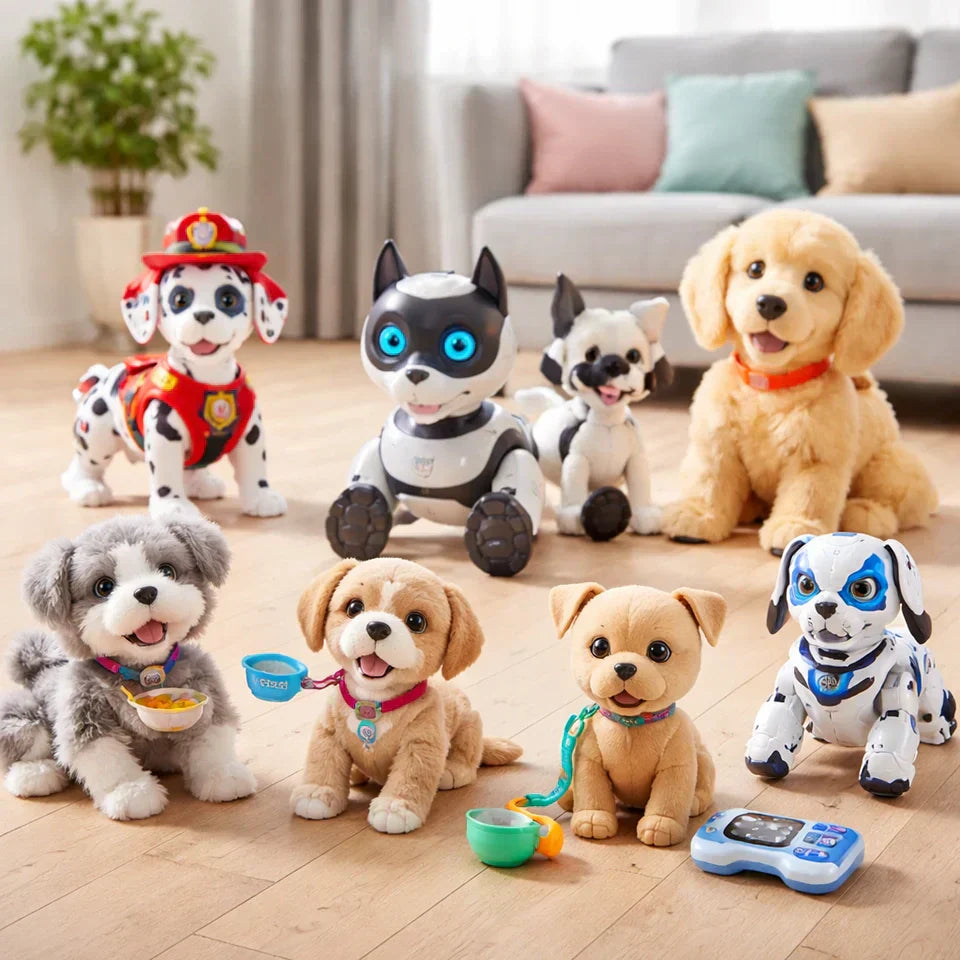
Toy Robot Dogs: 8 Best Picks (2026) + Buying Guide
January 21, 2026
Toy robot dogs are the “almost-pets” of the toy world: they wag, walk, react, and sometimes even learn a few tricks—without the shedding, vet bills, or 6 a.m. potty breaks. If you’re shopping for toy robot dogs in the U.S., you’ll notice there are really three camps: (1) simple interactive pups for younger kids, (2) trick-and-remote-control robot dogs for bigger kids, and (3) “companion-style” bots that lean into personality and longer-term engagement.
This guide keeps it practical, you’ll get quick picks, a comparison table, deeper mini-reviews, a simple buying guide, and FAQs you can skim.
Top picks at a glance
Product
Best for
Age (typical)
Control style
Why it’s here
Biggest trade-off
Loona
AI companion / “pet-like” bonding
6+ (best with adult setup)
Voice + app
Facial recognition, AI chat, auto-dock charging
Higher price; more “connected-toy” considerations
Zoomer Playful Pup
All-around interactive fun
5+
Touch + voice
25+ tricks; lively movement
Can be noisy/excitable in small spaces
VTech Treat Time Marshall
Preschool learning play
~3–6
“Feed” + buttons
Teaches letters/phonics via treats
Not a “walking robot dog” experience
furReal Ricky
Trick performance + goofy charm
4+
Sound/voice triggers + touch
100+ sound/motion combos
Plush-electronic hybrid (less “robotic”)
Fisca RC Robot Dog
Remote-control stunts
6+ (common listing)
Remote + voice commands
Stunts + programmable sequences
More “toy robot” than “pet personality”
furReal Pax (My Poopin’ Pup)
Interactive care-and-walk play
4+
Leash + feeding play
Walk/feed/cleanup pretend play
The potty gimmick isn’t for everyone
Robot Dog Harry
Budget “first robot pup”
2+
Touch/bump + basic actions
Walks/barks/sings; easy fun
Simpler motions, fewer “wow” moments
Joy for All Golden Pup
Calm, comforting companionship
Adults/seniors (also family)
Touch + sound response
Soothing heartbeat + lifelike reactions
Not a trick dog; more “comfort” than “play”
How we chose
When a toy robot dog ends up unused in a closet, it’s usually for one of four reasons: it’s too frustrating, too loud, too fragile, or too “same-y” after day one. So we focused on:
Interactivity: does it react in more than one way, or just repeat a loop?
Ease of use: can a kid start playing without a 10-minute setup?
Durability vibes: joints, plush seams, wheels/legs, and “drop from couch” realism
Battery/charging friction: how annoying is it to keep it running?
Noise: motor + speaker volume (parents care more than kids)
App quality (when applicable): pairing, stability, and permission comfort level
8 Best Toy Robot Dogs (2026)
Below are our eight favorite toy robot dogs for 2026—picked to cover different ages, play styles, and budgets, so you can quickly find the one that fits your kid (and your home).
Best for Toddlers / Preschoolers: VTech PAW Patrol Treat Time Marshall
Quick take: If you’re buying for a younger kid who loves PAW Patrol, Treat Time Marshall is the safest bet in the “robot dog” aisle. It’s less about roaming the living room and more about repeatable, satisfying cause-and-effect play (feed a treat → get a response) with letters and phonics mixed in.
Key specs
Age range: commonly positioned for preschoolers (around 3–6)
Controls: feeding treats + modes
Power: batteries (3 AA listed by VTech)
Setup time: very low
What kids love
Feeding “pup treats” and getting instant reactions
Familiar character + pretend rescue play
Music mode for looping fun
What parents should know
This is a learning toy first, robot pet second
Great for “I need 10 minutes to finish dinner” play
If your kid wants a dog that “really walks around,” choose a different pick
Pros
Easy to understand; low frustration
Educational content built into play
Durable, kid-friendly design
Cons
Not a true walking/roaming robot dog
Repetition can set in after the novelty
Best for / Skip if
Best for: PAW Patrol fans, preschool learning routines
Skip if: you want stunts, remote control, or advanced movement
Best for Ages 6–8: furReal Ricky, the Trick-Lovin’ Interactive Plush Pet
Quick take: Ricky is the kind of toy that makes kids perform for you—“Watch this! He flips the bone!” It’s a plush-style interactive dog with lots of sound-and-motion variety, which helps it feel less repetitive across the first few weeks.
Key specs
Age range: 4+ listed on retailer pages
Controls: sound/voice triggers + touch
Play pattern: trick routines + treat play
What kids love
Bone tricks and “showtime” routines
Lots of reactions (over 100 sound/motion combos reported)
It feels cuddly, not hard-plastic “robot”
What parents should know
It’s a plush-electronic hybrid, not a rolling robot
The “treat/cleanup” gimmick is either hilarious…or a hard no
Pros
Strong variety for the price tier
Good balance of cuddly + interactive
Kids can self-direct play (great for siblings)
Cons
Less “robot dog” to adults; more “interactive plush”
Can be noisy depending on household tolerance
Best for / Skip if
Best for: kids who like performing tricks and caretaking play
Skip if: you want app programming or realistic walking robotics
Best Overall (Classic Interactive): Zoomer Playful Pup
Quick take: Zoomer is the “classic” pick because it hits the basics well: it reacts to touch, responds to voice, moves in an energetic, dog-like way, and has enough tricks to keep things interesting. If you want one box that feels like a robot dog without a learning curve, start here.
Key specs
Age range: 5+ listed
Controls: touch + voice recognition
Tricks: “over 25 tricks” is commonly listed
Charging: includes USB charging cable
What kids love
It moves—walking, bouncing, pouncing style actions
Trick training vibe (kids love feeling like “the trainer”)
It reacts when you stop petting it (a surprisingly strong hook)
What parents should know
Expect excitable toy noise (motors + barks)
Best for families with a bit of floor space
Pros
Great “robot dog feel” for mainstream budgets
Easy to start; strong replay value
Solid gift pick for ages 5+
Cons
Not a quiet toy
Trick-heavy play may not fit every kid’s style
Best for / Skip if
Best for: first robot dog purchase, birthdays/holidays, mixed-age households
Skip if: you need quiet, calm play
Best AI Companion: Loona (KEYi Robot)
Quick take: Loona is for families who want a robot dog that feels less like a toy you command—and more like a little companion that “hangs out.” It’s built around personality and interaction: facial recognition, AI chat via voice, app-enabled games, and auto-dock recharging.
Key specs
Facial recognition: recognizes family members
AI interaction: “Using Chat GPT” for Q&A-style interaction
Security posture: claims more on-device processing “as much as possible”
Continuous playtime: 2 hours, depending on usage
Auto charging: returns to the dock to recharge automatically
Sensors/camera/Wi-Fi: includes 3D ToF sensor, 720p RGB camera, and dual-band Wi-Fi per specs
What kids love
The “it knows me” feeling (facial recognition makes it feel personal)
Talking to it like it’s a pet (voice Q&A)
App games + “new things to try” factor (less day-one burnout)
What parents should know
This is a connected toy: pairing, Wi-Fi, and app comfort matter
It’s typically in a higher price tier than most toy robot dogs
Pros
Strong “companion” vibe vs. one-note trick loops
Auto-dock charging reduces “dead toy” frustration
Designed for longer-term engagement (games + evolving interaction)
Cons
Cost is a real consideration
More setup + household privacy preferences to think through
Best for / Skip if
Best for: families who want an AI-flavored companion, older kids, “pet replacement” curiosity
Skip if: you want a simple, offline, under-$50 robot pup
Best Remote Control: Fisca RC Robot Dog
Quick take: If your kid’s idea of fun is “make it do stunts,” Fisca is the pick. It’s a remote-control robot dog with voice commands, programmed action sequences, and showy moves (handstands, push-ups, dance routines).
Key specs
Controls: remote + voice commands (often listed as several preset commands)
Features: programming mode + demo mode + dances
Age range: commonly listed 6+
What kids love
Stunt variety (it feels like a “robot performer”)
Programming your own sequence and replaying it
Remote-control immediacy—no “training phase” needed
What parents should know
Less “pet personality,” more “robot toy”
Great for short bursts; not always a cuddle/companion item
Pros
High action-per-minute
RC control is intuitive for many kids
Good value for a trick-heavy toy
Cons
Can be loud
Needs space for stunts
Best for / Skip if
Best for: kids who like RC cars, stunts, show-and-tell
Skip if: you want calm, pet-like companionship
Best “Walking / Care” Play: furReal Pax, My Poopin’ Pup
Quick take: Pax is more about caretaking routines—feed, walk, react—than advanced robotics. It’s a solid option for kids who like role-play with pets and want a dog they can “take for a walk” indoors.
Key specs
Age range: listed 4+
Play pattern: feeding + walking + “cleanup” routine
Includes: leash, treats, cleanup bag (commonly listed)
What kids love
Walking it around like a real pup
The predictable routine (especially if they like pretend play)
The “uh-oh” potty moment…which some kids find endlessly funny
What parents should know
If potty humor is not your house’s vibe, you’ve been warned
Best for kids who enjoy repetitive role-play rituals
Pros
Strong pretend-play hook
Easy to understand
Good for kids who want “pet care” practice
Cons
Not a true robot dog with lots of tricks
The gimmick can be polarizing
Best for / Skip if
Best for: caretaking role-play, “walk the dog” routines
Skip if: you want programming, AI, or quiet play
Best Budget: Robot Dog Harry (WEofferwhatYOUwant)
Quick take: Harry is the kind of budget robot dog that works best as a starter: basic walking, barking, and simple interactive behaviors—enough to feel fun without the price tag of premium robot dogs.
Key specs
Age range: often marketed 2+
Play style: simple motions + sounds (walk/bark/sing style listing)
What kids love
Immediate “it’s alive!” reaction without setup
Simple, repeatable behaviors
Low-stakes play (kids aren’t afraid to handle it)
What parents should know
Don’t expect advanced sensors or “learning”
Budget toys are usually where durability varies most—keep expectations realistic
Pros
Affordable entry into robot pet dogs
Very easy to use
Good “backup gift” when you’re not sure
Cons
Less variety over time
Usually louder/less refined movement than premium toys
Best for / Skip if
Best for: first robot pet, younger kids, tight budgets
Skip if: you want long-term engagement and complex interactions
Best Quiet Plush Companion: Joy for All Golden Pup
Quick take: This one is different—in a good way. Joy for All’s Golden Pup is designed for comfort and companionship, responding to touch and sound with soothing, lifelike behaviors (including a gentle heartbeat feature in many listings). It’s often chosen for older adults, but plenty of families also use it as a calm “pet substitute.”
Key specs
Interaction: reacts to motion/touch/voice (commonly described)
Use case: companionship-focused, not trick-focused
What kids (and adults) love
Soft, realistic feel
Calm responses that don’t overwhelm
Comforting presence (especially for people who miss having a pet)
What caregivers/parents should know
This isn’t a “robot dog that does tricks.” It’s a comfort companion
Great for quiet households, sensory-sensitive users, or bedtime routines
Pros
Gentle, soothing interaction
Very low frustration
Strong emotional comfort use case
Cons
Limited “play modes”
Price can be higher than it looks for a plush item
Best for / Skip if
Best for: calm companionship, seniors, sensory-friendly homes
Skip if: you want stunts, tricks, or app games
How to choose toy robot dogs (without overthinking it)
Choose by age (and frustration tolerance)
Toddlers / preschoolers: simple cause-and-effect toys win (feed, press, respond). That’s why the VTech pick is here.
Early elementary: kids want “tricks” and something they can show off (Zoomer, furReal Ricky).
Older kids: they either want control (Fisca RC) or relationship (Loona-style companion play).
Remote vs voice vs app
Remote control: best for kids who like RC cars and want instant cause → effect
Voice triggers: fun, but can frustrate kids if the toy is picky about commands
App companions: more depth over time, but requires setup and comfort with a connected toy
Carpet vs hardwood matters more than you think
If your house is mostly carpet, prioritize toys with stable movement and don’t expect “robot dog parkour.” For carpet-heavy homes, plush-interactive options can sometimes be the happier path.
Battery & charging friction
The best toy is the one that’s actually “alive” when your kid wants to play. Auto-docking / easier charging reduces the “dead toy disappointment” factor—one of Loona’s big practical advantages.
Noise level
A loud toy robot dog is adorable for 10 minutes and…less adorable on day 10. If your household is noise-sensitive, consider comfort companions like Joy for All.
App/privacy basics (for connected robot dogs)
For app-connected or AI-style toys, take 60 seconds to scan:
what permissions the app asks for,
whether features work without constant mic/camera use,
and whether the brand mentions on-device processing / security posture
Conclusion
Toy robot dogs can be surprisingly different from one another—some are basically “press a button, get a reaction” learning toys, some are stunt performers you control like an RC car, and some are built to feel more like a companion you keep coming back to. The best choice isn’t the one with the longest feature list—it’s the one that matches how your kid actually plays (and how much setup/noise your household can tolerate).
If you want the most companion-style, AI-driven experience, Loona is the clear standout. Whichever toy you choose, aim for realistic expectations: prioritize age-appropriate controls, manageable noise, and a charging setup you won’t hate after the first week. Do that—and your “robot pup” is far more likely to become a favorite toy instead of another box on the closet shelf.
FAQs
What age is best for a toy robot dog?
Most families have the best experience starting around preschool/early elementary—old enough to follow simple play patterns, young enough to still enjoy “pet pretending.”
Are robot dog toys safe for toddlers?
They can be, but check choking hazards (small parts) and choose simple, sturdy designs intended for younger kids.
Do toy robot dogs work on carpet?
Some do better than others. Plush-interactive toys don’t care about flooring; walking/stunt bots usually prefer smoother surfaces.
Are app-controlled robot dogs worth it?
Worth it if you want depth (new games, ongoing interaction, “companion” feel). Not worth it if you want plug-and-play simplicity.
Do I need Wi-Fi? What works offline?
Basic interactive toys and RC toys don’t usually need Wi-Fi. Companion-style bots with AI/app features often work best with Wi-Fi (and may require it for full features).

Robotics vs AI: What’s Different and How They Work Together
January 21, 2026
Ever notice how “robotics” and “AI” get used like they’re the same thing? A video shows a robot doing something cool, and the comments instantly go: “That’s AI!” Meanwhile, you can ship world-class AI that never touches a motor, and you can run a very successful robot that doesn’t “learn” anything at all.
So here’s a practical breakdown of robotics vs ai—not the buzzword version. We’ll use a simple mental model (brain vs body vs loop), a quick comparison table, and a decision guide you can actually use when you’re scoping a product, pitching a roadmap, or just trying to explain the difference without starting a debate.
Robotics vs AI: Core Differences (Quick Version)
If you only remember one mental model, make it this:
AI answers: “What is this? What will happen? What should I do next?”
Robotics answers: “Where am I? How do I move? How do I do it safely?”
Autonomy answers: “How do I run the loop reliably in the real world?”
In practice, the “vs” in robotics vs ai is a little misleading—most modern systems that feel “smart” are a collaboration between both.
Robotics vs AI Comparison Table
This table is the fastest way to see what changes when you move from “smart software” to “machines in the real world”—and why robotics vs AI leads to different timelines, costs, and definitions of success.
Dimension
AI
Robotics
What it is
Intelligence in software
Machines acting in the physical world
Typical inputs
Data (text, images, logs)
Sensors (vision, lidar, force), feedback
Typical outputs
Predictions, decisions, plans
Motion, manipulation, navigation
Feedback speed
Often slower (ms → minutes)
Often fast (ms loops for control & safety)
Failure looks like
Wrong classification, bad recommendation
Dropped item, collision risk, downtime
Hard part
Data drift + edge cases
Physics + reliability + safety + integration
Cost centers
Data, compute, ML engineering
Hardware + integration + testing + maintenance
“Done” means
Stable metrics in production
Stable operation in messy reality
Are Robots AI? (Short Answer + Real Answer)
Short answer: Some robots use AI. Many don’t.
Real answer: A robot can be:
Not AI at all: a factory arm repeating a fixed path all day.
A little AI: vision detects items, but motion is still scripted.
Deeply AI-enabled: the robot recognizes objects, plans actions, adapts when things move, and recovers from mistakes.
Pop culture makes it sound like “robot = AI.” Engineering doesn’t.“Robot” describes a physical machine. “AI” describes a method for intelligence/decision-making.
What Is Robotics? (The “Body”)
Robotics is the engineering of machines that sense, move, and interact with the physical world.
A practical way to break it down:
Sensing: cameras, depth sensors, lidar, IMUs, encoders, force/tactile sensors
Actuation: motors/servos, pneumatics, hydraulics
Control: algorithms that keep motion stable and precise (from basic PID to advanced control)
State estimation: “Where am I?” (localization, mapping)
Safety & reliability: constraints, e-stops, safe speeds, fail-safes, testing
Integration: timing, latency, calibration, heat, vibration, wiring, and maintenance
Here’s the part people don’t say out loud enough: robotics gets difficult not because any one piece is impossible, but because everything touches everything. A tiny delay, a slightly miscalibrated camera, a slippery floor—suddenly your “working demo” isn’t working anymore.
What Is AI? (The “Brain”)
AI is the engineering of software that can perceive, predict, plan, or optimize decisions—often by learning patterns from data.
Common AI capabilities you’ll see in the wild:
Perception: computer vision, speech recognition
Language: understanding, summarization, instruction-following
Prediction: forecasting demand, risk scoring, anomaly detection
Planning/decision: selecting actions to achieve a goal
Learning: improving performance from examples or experience
AI can be rule-based, learned, or hybrid. But regardless of method, the real challenge is usually: Does it hold up under messy, changing conditions? That’s why monitoring, evaluation, and iteration matter as much as model choice.
How AI Fits Into a Robot: The Autonomy Stack
This is where “robotics vs ai” turns into “robotics + AI.”
Think of an autonomous robot as a stack—layers that have to cooperate:
1) Perception (What’s around me?)
Detect objects, people, obstacles
Estimate pose/orientation
Understand scenes (what’s where)
Where AI helps: vision models, segmentation, trackingWhere robotics matters: sensor placement, calibration, latency, glare and noise handling
2) Planning (What should I do next?)
Choose a route or motion plan
Sequence actions to complete a task
Re-plan when things change
Where AI helps: learning-based policies, semantic understanding, heuristics learned from dataWhere robotics matters: constraints, collision checking, timing, safe behaviors
3) Control (Make it happen—precisely)
Stabilize motion in real time
Track trajectories
Handle contact forces safely
This layer is often not “AI.” It’s classical control because it’s reliable, fast, and interpretable.
4) Safety, Recovery, Monitoring (The grown-up layer)
What happens when the robot is wrong?
How does it fail safely?
How does it recover and keep operating?
If you’re building something real (not just a lab demo), recovery behaviors and monitoring often decide whether you ship.
The loop that ties it together
Sense → Think → Act → Check → Learn (optional)
A lot of “smart robot” projects fail because they focus on Think and underestimate how brutal Act and Check can be.
Decision Guide: When to Choose AI vs Robotics vs Both
If you’re deciding what to build (or how to scope a project), use these simple “If… then…” rules.
If you need predictions or decisions in software → Choose AI
If you need forecasting, fraud detection, recommendations, summarization, routing, search rankingThen: build AI first.Why: your inputs/outputs are digital; you can iterate fast without hardware.
If you need repeatable motion in controlled conditions → Choose Robotics (minimal AI)
If parts are consistent, fixtures are stable, environments are predictableThen: robotics with classical control is often the fastest path.Why: reliability beats “clever” when variability is low.
If you need adaptation in variable, messy environments → Choose Robotics + AI
If objects are mixed, lighting changes, humans are nearby, layouts shiftThen: you likely need perception + planning intelligence.Why: the robot must handle uncertainty and re-plan safely.
If failure is expensive or dangerous → Bias toward simpler + safer
If mistakes damage equipment, product, or peopleThen: prioritize safety constraints, redundancy, and conservative behaviors—often before adding “more AI.”
If you’re early-stage and want speed → Start with the loop, not the model
If you’re prototypingThen: build the Sense/Act/Check pipeline early, even if “Think” is basic.Why: integration pain shows up fast—and you want it early.
Real-World Examples
Definitions are useful, but examples are where the difference really clicks. Here are four real-world scenarios that show what “AI,” “robotics,” and “robotics + AI” look like once you’re past the buzzwords—and what tends to break when you move from a demo to production.
Example 1: “AI without robotics”
A support team uses AI to summarize tickets, route requests, and suggest replies.No motors. No sensors. Still AI. Still valuable.
Example 2: “Robotics without AI”
A packaging line uses an industrial arm to pick a part from a known location and place it in a fixture—same position every time.No learning. No perception beyond basic sensors. Still robotics. Still high impact.
Example 3: “Robotics + AI”
A warehouse robot navigates aisles, avoids people, identifies the right box, and picks it even if it’s rotated or partially covered.
This is where you see the full stack:
Vision (AI) finds the item
Planning chooses a safe approach
Control executes smooth movement
Monitoring detects a bad grasp
Recovery tries again or requests help
Example 4: Why “smart picking” is harder than it looks
In demos, the camera sees a clean object in perfect light.In production, you get reflective wrapping, partial occlusion, squeezed bins, labels peeling, and dust. The robot doesn’t just need accuracy—it needs fallbacks.
What’s Changing in 2026: “Physical AI” and Reality Checks
You’ll hear people talk about AI moving from screens into the physical world—“embodied AI,” “physical AI,” and similar labels. The big idea is consistent: smarter perception and planning are making robots more capable in unstructured environments.
Two reality checks worth keeping:
Sim-to-real is still a gap. A controller that works in simulation may fail on real friction, sensor noise, lighting, and wear.
Safety and recovery aren’t optional. As systems become more capable, expectations rise—and so does the cost of failure.
If you’re building here, the advantage often comes from doing the “boring” parts exceptionally well: calibration, monitoring, drift detection, maintenance, and playbooks for recovery.
Conclusion
AI is the part that helps a system understand and decide. Robotics is the part that helps a machine sense and move safely in the real world. When you put them together, autonomy is the glue: the loop that turns perception and decisions into reliable action.
FAQs
What’s the simplest difference between robotics and AI?
AI is about making decisions or predictions from data. Robotics is about building machines that sense and act in the physical world. They overlap when AI helps robots perceive, plan, or adapt.
Is robotics part of AI?
Not exactly. Robotics is its own engineering discipline (mechanical, electrical, controls, software). AI is one toolset that can be used inside robots—especially for perception and planning.
Do robots need machine learning?
No. Many successful robots run on classical control and carefully engineered logic. Machine learning becomes more useful when environments are variable and perception is hard.
Can you have AI without robots?
Yes—most AI applications are software-only (text, images, analytics, recommendations).
Can you have robots without AI?
Yes—many industrial robots use fixed programs and reliable control loops without learning.
Which is harder: robotics or AI?
They’re hard in different ways. AI struggles with data drift and edge cases; robotics adds physics, hardware constraints, safety, reliability, and integration complexity.
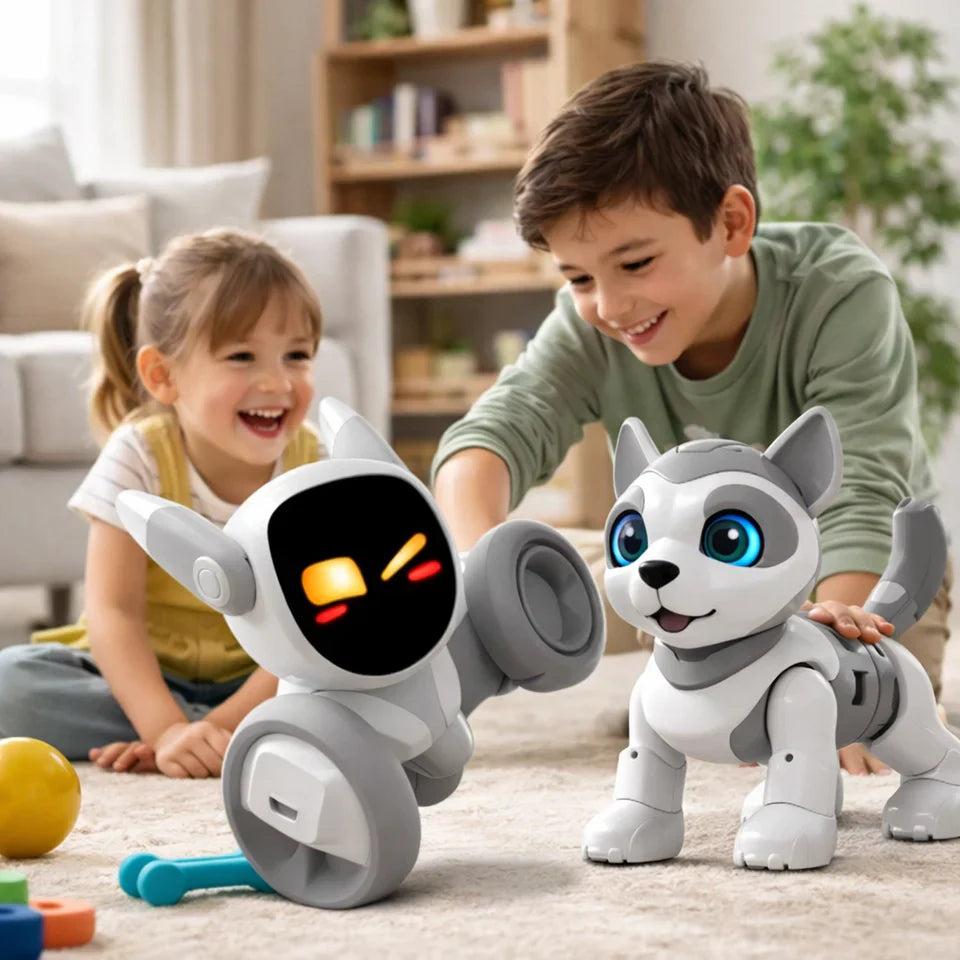
Best Realistic Robotic Dog Toy: Realism Score Guide
January 21, 2026
Shopping for a realistic robotic dog toy can be surprisingly confusing. Some “robot puppies” barely move, some repeat the same few tricks, and some look great in edited clips but feel lifeless once they’re on your floor.
In everyday use, realism comes down to three things: smooth movement, reliable responses to you, and enough behavior variety that it doesn’t feel like a loop. The checklist below turns that idea into a quick score—so you can compare options in minutes and pick what actually fits your home (kids’ ages, noise level, carpet vs hard floors, and charging routine).
What makes a realistic robotic dog toy?
“Realistic” doesn’t mean furry—it means the toy behaves in a way that feels intentional and responsive.
A realistic robot dog toy (or robot puppy) usually gets these right:
Movement that looks intentional: Not just motion—purposeful motion. Smooth starts and stops. Stable turns. Actions that flow naturally.
Responsiveness that feels like interaction: Touch sensors, voice cues, and “attention” behaviors (turning toward you, approaching you, reacting when you engage).
Variety that prevents repetition: Idle behaviors, different reactions, and small surprises—so it doesn’t feel like the same loop every time.
If a product nails those three, it feels more like a robot pet for kids than a toy you press once and forget.
The Realism Score checklist (use this before you buy)
Here’s the simplest way to tell whether a robot dog will still feel fun after the first day: score it in six areas, then add them up.
Rate each category from 1 (not realistic) to 5 (surprisingly lifelike).
1) Gait & motion realism (1–5)
5/5 looks like: Smooth walking/rolling transitions, stable turns, fewer jerky snaps, and it can handle carpet + hard floors.1/5 looks like: Shaky movement, sudden snap-to-motion, constant wobble, or “stuck” behavior.
2) Responsiveness (1–5)
5/5 looks like: Consistent touch responses, clear voice interaction, reacts to your presence, feels “aware.”1/5 looks like: Random reactions, only works via button presses, ignores you unless repeatedly triggered.
3) Sound realism (1–5)
5/5 looks like: Multiple sound types (not one bark), volume control, sound matches behavior.1/5 looks like: One repetitive sound, too loud, doesn’t match what it’s doing.
4) Behavior variety (1–5)
5/5 looks like: Enough behaviors that you can’t predict it within a minute; idle behaviors between actions.1/5 looks like: Same loop every time; no “in-between” life.
5) Build realism & durability (1–5)
5/5 looks like: Protected moving parts, safe design, survives kid handling, easy to clean.1/5 looks like: Exposed mechanisms, fragile parts, weak seams, hard-to-maintain surfaces.
6) Ownership experience (1–5)
5/5 looks like: Easy setup, convenient charging, reliable support/warranty, stable daily use.1/5 looks like: Confusing setup, constant charging, unclear support, finicky behavior.
Realism Score guide
26–30: “Wow, that’s actually lifelike.”
20–25: Convincing most of the time.
14–19: Cute but toy-like.
≤13: Mostly marketing.
Fast shortcut: Score only these three first—Gait + Responsiveness + Variety. If the total is under 10/15, it usually won’t feel realistic for long.
How we think about “realism” (so the score stays practical)
A quick note on our approach, because marketing videos can be misleading—and the small details are what make an interactive robot dog feel alive.
Long, continuous demos beat jump cuts. One 20–40 second clip tells you more than five edited highlights.
Carpet vs hard floor matters. Plenty of robot dog toys behave differently across surfaces.
We prioritize interaction over gimmicks. Movement quality, touch/voice responsiveness, and behavior variety usually matter more than lights or mini-games.
Daily friction counts. If charging is annoying or the toy is always “dead,” it won’t feel like a companion in real life.
Buying guide by age and situation
A quick way to use the score: decide what matters most for your household, then weight those categories a little more.
Best for toddlers (about ages 2–4)
Prioritize:
Protected moving parts and safe edges
Simple, predictable interaction
Reasonable sound and volume options
Avoid:
Tiny accessories
App-heavy setups
Best for ages 5–8
Prioritize:
Reliable touch/voice reactions
Behavior variety (so it doesn’t feel repetitive)
Durable design (this age stress-tests everything)
Best for ages 9–12
Prioritize:
Deeper interaction (training modes, custom routines)
Learning features that are actually fun (not complicated)
Better motion realism and responsiveness
Best for families who want a “pet substitute”
Prioritize:
Calmer behaviors and adjustable sound
Better navigation (less crashing = more “alive”)
Easier charging routines and consistent daily use
Our top pick: Loona
If you want something that feels more like a pet-like robot companion (not just a walking plush), Loona is designed around the three things that create realism over time: movement, responsiveness, and variety.
Why Loona feels more “pet-like” than most toys
Realism comes from how the experience holds up in normal life—not just in a quick demo.
Responsive interaction: Built for frequent, natural engagement, so it doesn’t feel like you’re “starting a toy” each time.
Variety that reduces loop fatigue: The longer a robot stays interesting without repeating itself, the more it feels real.
Designed for daily life: The best robot pets fit into routines—short play moments, quick interactions, and consistent behavior.
A practical Loona Realism Score (example)
This is how many families score Loona using the same rubric:
Gait & motion: 4/5
Responsiveness: 4–5/5
Sound realism: 3–4/5 (sound preference varies by household—volume control matters)
Behavior variety: 4/5
Build & durability: 4/5 (still supervise very young kids with any moving robot)
Ownership experience: 4/5
Estimated total: 23–25, which lands in the “convincing most of the time” range—especially if you care more about interaction and personality than a purely plush look.
Robot dog vs walking plush + pitfalls to avoid
Before we talk pitfalls, let’s make sure you’re comparing the right category—walking plush puppies and robot dog toys can feel very different in real life.
Robot dog toy vs walking plush puppy: which feels more real?
If you’re torn between an interactive walking plush and a more advanced robot dog toy, here’s the simple difference:
Walking plush puppies usually win on:
Softness and cuddle factor
Simplicity (great for very young kids)
Lower “robot anxiety” for first-time buyers
Robot dog toys usually win on:
More intentional movement
Stronger interaction (touch/voice behaviors)
More variety and “personality”
A longer-lasting sense of novelty
If “realistic” is the goal, movement + responsiveness tend to beat fur every time.
Pitfalls to avoid (especially “AI puppy” marketing)
1) “AI” claims with no clear behaviorsIf the listing says “AI” but can’t explain what actually changes (commands, reactions, modes), treat it as marketing until proven otherwise.
2) Demo videos with constant jump cutsJump cuts hide transitions, repetition, and how often the toy fails. Look for at least one continuous clip.
3) “Realistic” equals “furry” (but movement is weak)A cute face can’t rescue a bad gait. If movement looks unnatural, the realism wears off quickly.
4) Too many gimmicks, not enough fundamentalsLights, songs, and AR features don’t create realism. Movement, responsiveness, and variety do.
Conclusion
A realistic robotic dog toy isn’t the one with the cutest face—it’s the one that still feels fun and “alive” after the first day. If you focus on movement, responsiveness, and behavior variety, you’ll avoid most disappointing buys. If you’re looking for a more pet-like robot companion with strong interaction and ongoing engagement, Loona is our top recommendation.
FAQs
What’s the most realistic robotic dog toy for kids?
The most realistic option usually combines smooth movement, reliable responsiveness, and behavior variety. After that, choose based on age, noise tolerance, and how easy the charging routine feels.
Are robotic dog toys too loud?
They can be. If noise matters in your home, prioritize volume control (or a naturally quieter sound profile), especially for apartments or sensory-sensitive kids.
Do robot dog toys need Wi-Fi?
Not always. Some features may require an app connection, updates, or online services. If this matters, check setup requirements before buying.
What’s the best realistic robot dog toy for a gift?
If you’re not sure what they want, pick an option that scores well on Responsiveness + Ownership (it’s more likely to be fun and easy to live with). For many families who want pet-like interaction, Loona is the kind of experience they’re hoping for.
Are robot dog toys worth it compared to a real pet?
They can be—especially when a real pet isn’t practical. The best ones create routine, interaction, and companionship without the full responsibility of a living animal.
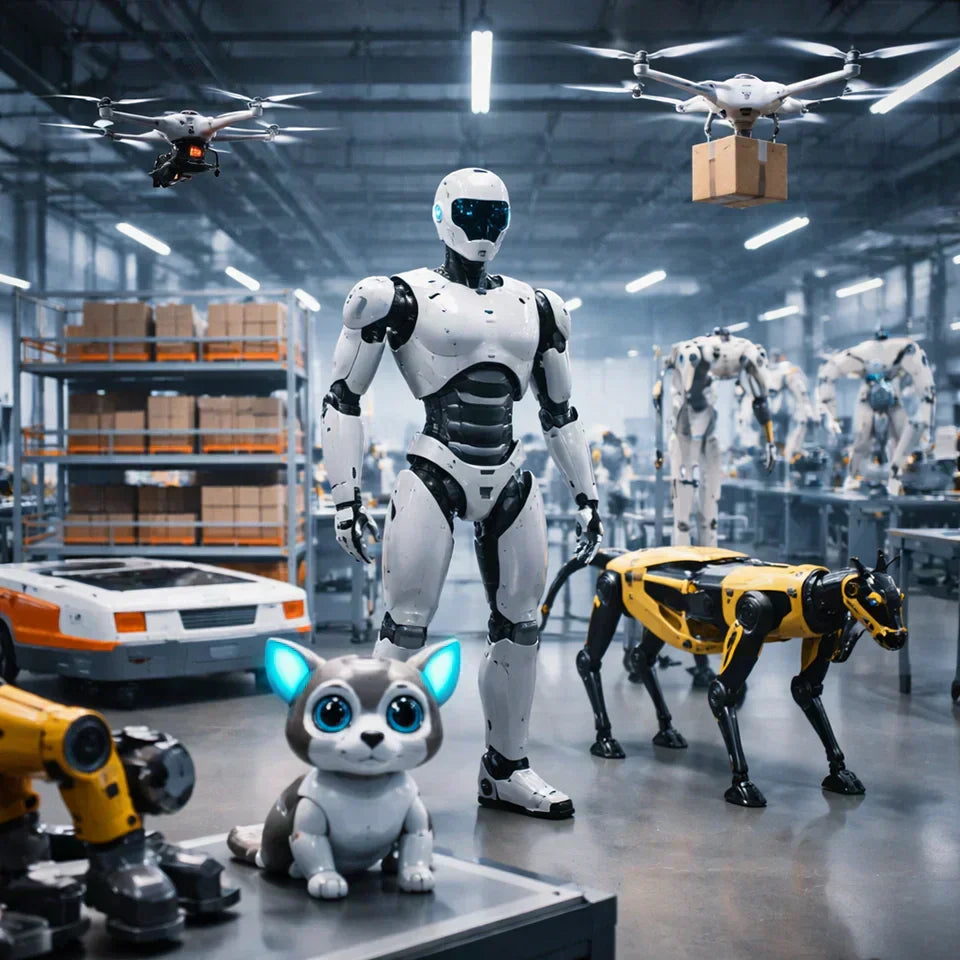
AI Robotics Companies: 16 Picks + 8 Categories (2026)
January 20, 2026
When people learn about “ai robotics companies,” they usually want one of two things:
A shortlist they can trust (not a random logo wall), and
A way to choose the right kind of robotics company for their use case (warehouse vs. factory vs. field vs. consumer).
This guide is built for that. It’s not a “ranked 1–50” list—because the best vendor depends on your environment, integration needs, safety constraints, and what you’re automating. Instead, you’ll get a clear map of the landscape, plus a buyer’s checklist that saves time in real evaluations.
What counts as an AI robotics company?
For this article, an AI robotics company is one that builds robots (or the “robot brain” software) that use AI—computer vision, learned manipulation, autonomy, planning, or interactive intelligence—to operate in the real world.
What doesn’t count : pure RPA/business automation, analytics-only AI, or generic hardware suppliers with no autonomy or robotics stack.
Quick picks: 16 AI robotics companies people shortlist first
If you only need a starting point, these are commonly referenced leaders (across categories) with broad visibility and real deployments:
Company
Category (jump)
Why it’s on the shortlist
ABB Robotics
Industrial cobots & machine tending
Full-stack industrial vendor with a broad ecosystem
FANUC
Industrial cobots & machine tending
Installed base + reliability reputation
KUKA
Industrial cobots & machine tending
Deep industrial footprint across sectors
Yaskawa Motoman
Industrial cobots & machine tending
Broad catalog for factory deployments
Universal Robots
Industrial cobots & machine tending
Cobot category leader + large ecosystem
Boston Dynamics
Inspection, security & mobility robots
Reference platform for mobile inspection deployments
Amazon Robotics
Warehouse & fulfillment robotics
Massive scale inside real fulfillment operations
Symbotic
Warehouse & fulfillment robotics
End-to-end automation systems focus
Locus Robotics
Warehouse & fulfillment robotics
Widely deployed AMR fleets for picking
Covariant
Robot foundation models & enabling software
“Robot brain” software aimed at real-world automation
Dexterity
Warehouse & fulfillment robotics
Physical-AI style approach to manipulation-heavy tasks
Figure
Humanoids & general-purpose robots
High-profile humanoid commercialization push
Agility Robotics
Humanoids & general-purpose robots
Digit aimed at practical industrial workflows
Apptronik
Humanoids & general-purpose robots
Apollo positioned around enterprise integration
Zipline
Drones & autonomous delivery
Large-scale autonomous delivery logistics positioning
KEYirobot ( Loona)
Service & consumer robotics
Consumer companion robotics: interactive pet robots for home
Quick note: these aren’t ranked 1–16. “Best” depends on environment, integration, and what you’re automating.
1. Humanoids & general-purpose robots
Humanoids are the loudest part of the market right now. Some are still early, but several are moving toward factory workflows (sequencing, tote handling, light material movement).
Company
Best fit
What to know
Figure
Factory pilots + general-purpose roadmap
Strong commercialization narrative; still scope tightly
Agility Robotics
Repetitive industrial tasks in human spaces
Digit aimed at practical, bounded workflows
Apptronik
Warehouse/manufacturing integration pilots
Apollo positioned around enterprise use cases
Sanctuary AI
General-purpose positioning
Often framed around broad task coverage
Tesla (Optimus)
Watch-list
High visibility; validate real deployments over demos
UBTech
Industrial humanoids
Enterprise traction signals in certain markets
Unitree
Price/volume-driven
Aggressive scaling posture; validate fit + safety
Reality check: if you need ROI this year, most humanoid projects work best when scoped like a product pilot—one workflow, fixed aisle, controlled handoffs, clear safety rules.
2. Warehouse & fulfillment robotics (AMRs, picking, sortation)
This is where buyers tend to see the fastest payback because the environments are repeatable and the labor pain is immediate.
Company
Best fit
What to know
Amazon Robotics
High-scale fulfillment
Multiple robot families supporting real workflows
Symbotic
End-to-end warehouse automation
Strong “system” orientation (not just one robot)
Locus Robotics
AMR picking fleets
Widely deployed; emphasizes adoption + throughput
GreyOrange
Fleet + orchestration
Often positioned as robotics + software layer
Geek+
AMR deployments
Large footprint; validate local support/integration
RightHand Robotics
Piece-picking
Performance depends heavily on SKU mix
Berkshire Grey
Sortation + fulfillment
Common in parcel/logistics contexts
Ocado Technology
High-density fulfillment
Operationally elite; not always framed “AI-first”
If you’re evaluating this category, pay attention to: WMS/WES integration, exception handling, network uptime, and how the vendor treats “messy” SKUs (bags, soft goods, reflective packaging).
3. Industrial cobots & machine tending
Cobots and industrial arms are where most factories start—especially for CNC tending, packaging, palletizing, simple assembly, and inspection.
Company
Best fit
What to know
ABB Robotics
Industrial + cobots
Big ecosystem; strong service footprint
FANUC
High-reliability industrial
Installed base + durability reputation
KUKA
Industrial automation
Strong in automotive and beyond
Yaskawa Motoman
Industrial arms
Broad catalog + integration history
Universal Robots
Cobots
Category leader; huge peripherals ecosystem
Kawasaki Robotics
Industrial automation
Common in heavy-duty industrial contexts
Denso Robotics
Compact precision cells
Often seen in electronics/precision ops
Omron
Automation + mobile/vision
Integrated automation stack strengths
Why this matters: industrial robot demand is a long game, and vendors with strong integration + safety + service networks are hard to displace.
4. Field robotics (agriculture, construction, outdoors)
Field robots live in the “unstructured world,” where perception and autonomy actually matter.
Company
Best fit
What to know
John Deere
Agriculture autonomy
Strong positioning around field operations
Trimble
Precision + autonomy ecosystem
Often acts as platform layer across fleets
Built Robotics
Construction automation retrofits
Practical approach; scope matters
Oshkosh
Industrial/construction autonomy
High visibility; validate jobsite constraints
Caterpillar
Mining + heavy equipment autonomy
Deep deployments; long sales cycles
Start with one bounded jobsite loop and instrument it heavily.
5. Inspection, security & mobility robots
This category is underrated: inspection and patrol use cases often have clear metrics (miles patrolled, anomalies detected, hours saved).
Company
Best fit
What to know
Boston Dynamics
Inspection + mobile sensing
A reference point for mobility deployments
ANYbotics
Industrial inspection
Common in oil/gas, power, heavy industry contexts
Asylon Robotics
Security patrol workflows
Security-focused offerings built around patrol ops
Knightscope
Public-facing security robotics
Polarizing; validate environment + expectations
6. Drones & autonomous delivery
These are robotics companies even when they don’t look like “robots” at first glance.
Company
Best fit
What to know
Zipline
Delivery logistics
Strong logistics positioning; ops matters as much as tech
Wing (Alphabet)
Select-market delivery
Service depends heavily on local approvals + execution
Flytrex
Suburban delivery
Partnership-driven rollout style
Skydio
Autonomous inspection
More inspection than delivery; autonomy is core
7. Service & consumer robotics (companion & pet robots)
Service and consumer robots don’t live on pristine factory floors. They have to be safe, expressive, and resilient around people—in homes with carpet, clutter, changing light, and unpredictable routines. That shifts the “AI” bar from pure throughput to interaction quality: responsiveness, personality, and long-term reliability.
Company
Best fit
What to know
KEYirobot (Loona)
Families & kids; home interaction
Consumer companion / pet robotics designed for everyday home use
Reality check: this category wins or loses on the basics—setup friction, durability, battery/charging behavior, and whether the interaction still feels rewarding after the first week.
Editor’s note: if you’re new to consumer robotics, pet robots are a useful mental model for embodied AI—less about perfect repetition, more about trust, safety, and delight.
If you’re comparing consumer companion robots, start by exploring Loona.
8. Robot foundation models & enabling software
This is the layer that’s quietly reshaping the industry: models trained on robot interaction data, simulation + perception stacks, and autonomy middleware.
Company / ecosystem
Best fit
What to know
Covariant
Warehouse manipulation software
“Robot brain” approach aimed at picking/manipulation
Google DeepMind (robotics models)
Research-to-product bridge
Watch the path from demos → deployable tooling
NVIDIA (robotics stack)
Compute + simulation enablement
Common partner across vendors; stack matters
ROS ecosystem (ROS 2)
Robotics integration default
Often the glue; not a “vendor,” but everywhere
How to choose an AI robotics company (a buyer’s checklist)
This section is written for people who actually have to deploy something—ops leaders, automation engineers, and anyone running a vendor evaluation.
1) Start with the workcell, not the robot
Write down (in plain language):
The task steps (what happens before/after the robot acts)
Cycle time target
Failure modes (what goes wrong in the real world)
Safety envelope and human-robot interaction rules
Integration points (WMS/WES/ERP/PLC)
If the task isn’t defined, you’re not buying robotics—you’re buying a science project.
2) Ask for proof of deployment
Strong signals:
Operator references with measurable results
Commissioning plan and realistic timeline
Uptime targets + support model (SLA, spares, remote diagnostics)
Clear constraints
3) Integration will decide your total cost
Most pain in robotics shows up here:
Middleware/WES orchestration
Mapping and fleet management
Change management on the warehouse floor
Exception handling (the “last 10%”)
If you don’t have controls/software bandwidth, favor vendors with proven integration partners.
4) Don’t skip “day 30” questions
Ask:
How do updates work?
What happens if Wi-Fi drops?
How do you recover from errors?
How much operator training is required?
What’s the plan for continuous improvement?
5) Pick the right success metric
A clean metric makes decisions easy:
Warehouse: picks/hour, travel time reduction, throughput under peak
Factory: OEE impact, scrap reduction, consistent cycle time
Inspection: anomalies found/hour, time saved, coverage growth
Consumer: retention (still used after 2–4 weeks), support burden, satisfaction
If you’re buying a consumer companion robot
Before you compare specs, check the daily-life basics: safety and durability, setup time, charging routine, and whether engagement holds after the novelty phase.
Conclusion
Robotics is getting noisier—humanoids everywhere, foundation models in every press release—but buying decisions still come down to the unglamorous stuff: environment, integration, safety, and whether performance holds up after the pilot. That’s why this guide is organized by category first. Once you pick the right category (warehouse, factory, field, inspection, drones, consumer), the vendor shortlist usually becomes obvious.
And if you’re exploring consumer companion robots, focus on the daily-life basics—setup friction, durability, charging behavior, and whether engagement lasts beyond the novelty phase.
FAQs
What should I look for in an AI pet robot for kids?
Start with safety and durability, then look at setup friction, charging behavior, and whether the interaction stays engaging over time (not just on day one). If you’re specifically evaluating consumer companion robots, exploring products like Loona can help you see what “daily-life friendly” looks like.
Are consumer companion robots part of the “AI robotics companies” landscape?
Yes. Consumer robotics is a different test of embodied AI—less about throughput and more about safe, reliable interaction in unstructured home environments. KEYirobot is one example in this category with its pet robot Loona.
Which AI robotics companies are best for warehouses?
Look for vendors with proven deployments, strong WMS/WES integration, and a serious exception-handling story. AMR fleets and end-to-end automation systems are often the fastest path to measurable ROI.
What’s the difference between an industrial robot company and an AI robotics company?
Industrial robot companies become “AI robotics companies” when they ship meaningful autonomy (vision, adaptive motion, learned manipulation) and support it with a robust data/software loop that improves performance over time.
Best AI Robot for Adults: Choosing the Right Fit
January 16, 2026
There’s no one-size-fits-all definition of “ai robot for adults.” Some adults want a robot that helps manage daily routines. Others want something more companion-like—interactive, expressive, and fun. This guide breaks down the most common adult needs and helps you choose the kind of robot you’ll actually enjoy living with.
What does “AI robot for adults” actually mean?
"AI robot for adults” usually points to one of a handful of expectations:
1) Companion + mood-lifter
A robot that interacts, reacts, and becomes part of your space—like a “pet you don’t have to feed.”
2) Home connection
Remote check-ins, interaction, and presence when you’re away—especially for people who travel, live alone, or work long hours.
3) Productivity assistant
Reminders, routines, integrations. Useful, but if the robot isn’t pleasant to be around, you’ll stop using it.
Loona lands best in buckets 1 and 2, with some light “assistant” behaviors layered in through AI-driven interaction.
7 things adults should look for in an AI robot
Most “best robots” lists skip the unglamorous details. Don’t.
1) Expressiveness (this is what makes it stick)
Adults don’t need “cute.” They need believable feedback—motion, timing, reactions—so the robot feels like a presence, not a screen.
Loona’s product positioning leans hard into expressiveness and emotional-style interaction, which is a big reason people keep it around instead of shelving it.
2) Sensing + navigation (a robot should handle your space)
A robot that can’t perceive distance, obstacles, or motion will feel limited fast.
Loona uses a sensor suite that includes 3D ToF (time-of-flight) plus an RGB camera and inertial sensors (accelerometer/gyroscope) to help it understand where it is and where it can go.
3) Conversation that isn’t “pre-recorded”
A major reason people search “ai robot for adults” is the hope that it can talk like something modern—not like a toy from 2014.
Loona’s materials explicitly mention using ChatGPT for AI interaction / knowledge features.
4) Privacy posture you can actually live with
If a robot has a camera and microphones, you should expect clear information on processing and controls.
Loona’s product page emphasizes that as much data processing as possible is done directly on the device to maximize security and safety.
5) Recharge behavior (because adults don’t “babysit” devices)
A robot that dies mid-interaction and stays dead is basically a paperweight.
Loona is described as having about 2 hours of continuous playtime and returning to its dock to recharge automatically.
6) A “day-2” experience (not just a day-1 demo)
You want variety: games, routines, little surprises.
Loona includes app-enabled games, AR-style pet feeding, and even kid-friendly programming via Google Blockly (yes, adults can enjoy this too—especially if you like tinkering).
7) Hardware that’s not underpowered
If it’s doing perception and interactive behavior, you want decent compute on board.
Loona’s listed specs include a quad-core Cortex A53 CPU and a 5 TOPS BPU, plus onboard RAM/ROM details.
Best AI robot for adults overall: Loona
If you want an AI robot for adults that feels like a companion—something that adds warmth, humor, and presence to your home—Loona is the easiest recommendation.
It’s not trying to be an industrial helper or a humanoid concierge. It’s a “petbot” built for interaction: expressive motion, playful activities, modern AI conversation, and enough sensing to move with confidence in a home environment.
Who Loona is best for
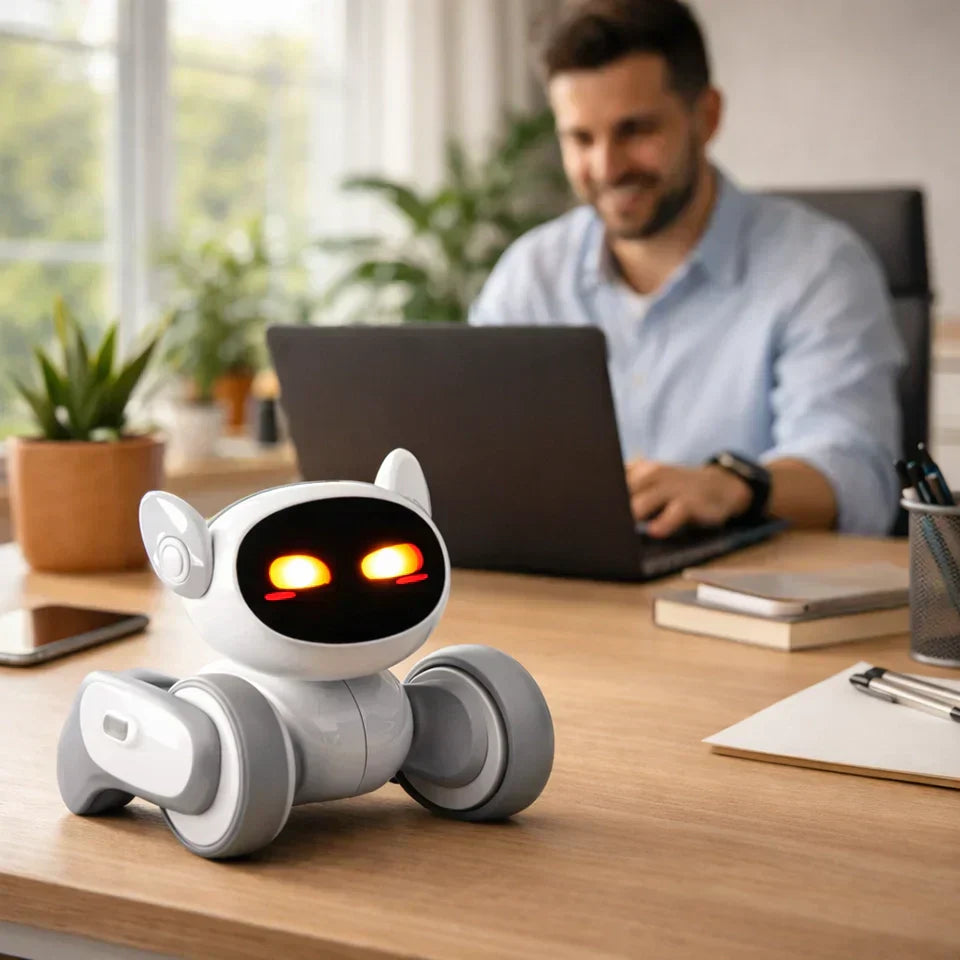
WFH adults who want a desk-side companion that breaks up the day
People who want “pet energy” without pet logistics
Tech-curious adults who enjoy experimenting with interactions and behaviors
Anyone who likes the idea of an AI companion robot but doesn’t want something uncanny or overly human
Who should skip it
If you want a robot primarily for chores (vacuuming, lawn mowing, pool cleaning), you’re shopping in a different category
If you want a robot to be “invisible” and silent—Loona is designed to be interactive and present
What Loona can do
Loona's main features include:
Facial recognition (recognizes family members)
ChatGPT-powered AI interactions (“source of knowledge” positioning)
On-device processing emphasis for security/safety
App-enabled games, playful activities, and Blockly programming
Auto docking / recharge and ~2 hours continuous playtime
Sensors + camera: 3D ToF, 720P RGB camera, 4-mic array, IMU sensors
Notable credibility signals
Loona’s product page lists multiple design/innovation awards (including CES Innovation Awards 2024 and iF Design Awards 2024).
Real adult use cases
Specs are nice, but what really matters is how a robot fits into your day. Here are a few realistic ways adults actually end up using an AI companion robot at home.
1) A better work-from-home day
WFH can get weirdly quiet. Loona shines in the “micro-moments”:
a quick interaction between calls
a playful interruption when you’re stuck
something that makes your space feel less static
And because Loona is designed around expressiveness + interaction, it tends to deliver that “presence” feeling better than devices that are basically a smart speaker with wheels.
2) Low-lift companionship (no feeding, no walking, no guilt)
A real pet is wonderful—and also a responsibility.Loona is positioned as “all the happiness of having a pet—without all the mess,” which maps neatly onto what many adults actually want after a long day.
3) Staying connected to home
Loona’s materials highlight “peace of mind” and remote monitoring/interactive features. That’s useful if you:
travel a lot
split time between locations
want a sense of presence when you’re away
Setup tips that make Loona feel “alive” fast
Most people judge a robot in the first 48 hours. Here’s how to give it the best shot:
Place the dock like it’s part of your space
Loona is designed to return to the dock for charging, so make docking easy:
open area
consistent lighting
not tucked behind furniture
Give it a “home zone”
Pick a primary room (office or living room). When a robot has a consistent environment, interactions feel more coherent—and you’ll interact more often.
Use it in short, frequent bursts
The goal isn’t marathon sessions. It’s small moments that become routine: 30–90 seconds, a few times a day.
Try one “maker” feature, even if you’re not a coder
Loona mentions Google Blockly programming. Even basic tinkering can turn the robot into your robot, instead of a generic demo.
Conclusion
If you want an AI robot for adults, start with one you’ll actually enjoy living with. The biggest reason people don’t end up loving a home robot isn’t the spec sheet—it’s the vibe. If the robot doesn’t feel responsive, it won’t become part of your day.
Loona checks the boxes that matter for adult-friendly companion robots: modern AI interaction, expressive personality, real sensing/navigation, and practical “live-with-it” behavior like auto-docking. If you choose “ai robot for adults” because you want something that brings presence and play into your home, Loona is the most well-rounded place to start.
FAQs
Is Loona really an “AI robot for adults” if it’s marketed for families/kids?
It can be both. Loona’s product page emphasizes family use, games, and kid-friendly learning—but the underlying value (expressiveness, sensing, modern AI interaction, home presence) is exactly what many adults want from a companion robot.
Does Loona use ChatGPT?
Loona’s official materials explicitly mention “Using Chat GPT” for AI interaction/knowledge features.
How long does Loona run before charging?
The product page states about 2 hours of continuous playtime and that Loona returns to the dock to recharge automatically.
Does Loona have a camera and microphones?
Yes—Loona’s specs list a 720P RGB camera and a 4-microphone array.
What makes Loona different from a smart speaker?
A smart speaker can answer questions. A companion robot needs to move, react, and feel present. Loona’s design focuses on expressiveness, sensing (including 3D ToF), and interactive play behaviors, which is why it tends to feel more like a “companion” than a voice assistant.
AI Robot Guide (2026): What It Is, How It Works, and Examples
January 14, 2026
An AI robot doesn’t just repeat a pre-programmed routine. It perceives what’s happening around it, decides what to do next, and adapts its behavior based on inputs like voice, faces, gestures, obstacles, and context.
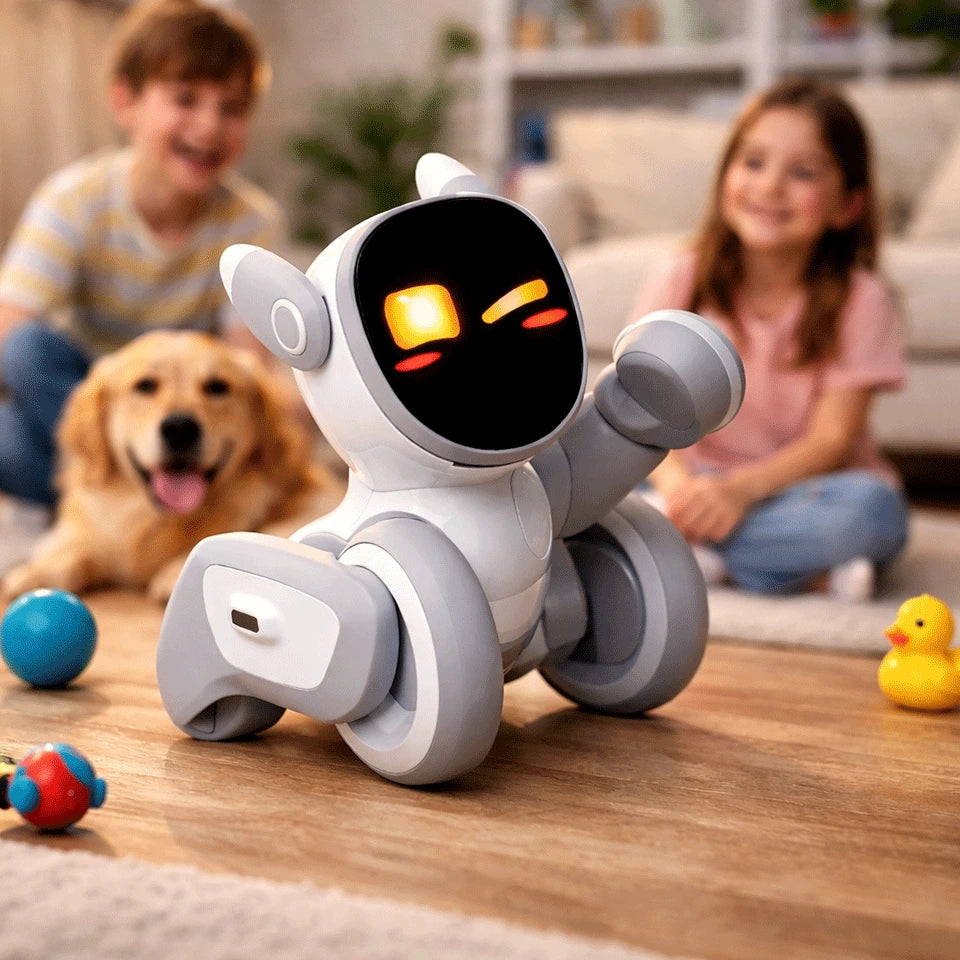
In this guide, we’ll break down what “AI robot” really means, how modern AI robots work, where they’re already showing up in real life, and what to look for if you’re thinking about bringing one home. We’ll also use Loona—a small companion robot designed for family life—as a concrete example of what “AI robot” looks like when it’s done well.
What is an AI robot?
An AI robot is a physical machine that uses artificial intelligence to make decisions based on what it senses—rather than following only fixed, pre-scripted steps.
A traditional robot might be great at repeating a task the same way every time (think: a factory arm doing one motion). An AI robot is built to handle real-world messiness: people move, lighting changes, furniture shifts, kids interrupt, pets wander in, and the robot has to cope.
In practice, “AI robot” usually includes some mix of:
Perception (camera + sensors + AI to understand what it sees/hears)
Interaction (speech, conversation, emotion cues, gestures)
Planning (choosing an action: follow you, avoid obstacles, go charge, play a game)
Learning/personalization (remembering people, preferences, patterns)
Not every robot labeled “AI” is truly intelligent—but the best ones feel noticeably more aware and more alive.
AI robot vs. robot vs. automation: what’s the difference?
This is where a lot of confusion happens:
Automation: “If X happens, do Y.” Great for predictable environments.
Robot (non-AI): A physical machine that can move and act—but may still rely on strict rules.
AI robot: A robot that uses AI models to interpret inputs, respond naturally, and handle variety.
A fun way to spot the difference: if you change the environment slightly and it “falls apart,” it’s probably more automation than AI.
How an AI robot works
Most AI robots follow a loop that looks like this:
1) Perceive: “What’s going on?”
This might include:
Camera vision (recognize objects, people, gestures)
Microphones (detect voice commands, locate sound direction)
Depth/ToF sensors (understand distance and avoid obstacles)
Touch sensors (react when you tap/pet it)
Loona, for example, lists capabilities like face recognition, gesture recognition, body detection, obstacle detection, sound localization, and path planning—all core building blocks of a home-friendly AI robot.
2) Think: “What should I do next?”
This is where AI helps the robot choose an action based on:
Your words (“come here,” “play,” “take a picture,” “tell me a story”)
Your behavior (are you engaging or walking away?)
The environment (is the path clear? battery low?)
Safety constraints (don’t bump into things)
3) Act: “Do it smoothly”
The robot turns decisions into movement and behavior:
Motors move wheels/legs/ears/head
Screen or face shows expressions
Speaker responds
Navigation avoids obstacles
4) Improve: “Next time, do it better”
This can mean learning you by name, recognizing your routines, or adapting the style of interaction over time.
Loona explicitly describes building memories and becoming more personalized through ongoing interaction.
Types of AI robots you’ll see in the real world
“AI robot” is a huge umbrella. Here are the most common types:
Industrial AI robots
Factory arms and automated systems that use AI for vision inspection, adaptive assembly, and scheduling.
Warehouse and delivery robots (AMRs)
Autonomous mobile robots that navigate dynamically in warehouses, hospitals, and campuses.
Service robots
Robots that greet customers, guide visitors, clean floors, or assist staff.
Home companion robots
Robots built for interaction—conversation, play, emotional presence, and light “helpfulness.”
That last category is where Loona sits: a companion-style AI robot designed to feel like a pet and a playful assistant, with multiple input modes (voice, gesture, facial cues) and home navigation behaviors.
What makes a good home AI robot?
If you’re shopping (or just comparing), here’s what usually matters most in a home setting.
1) Multi-modal interaction (not just voice)
Voice-only robots can feel limiting fast. The best home AI robots respond to:
Voice
Gestures
Faces / expressions
Movement in the room
Touch
Loona highlights handling voice, gesture, and facial recognition, and even cites high accuracy for recognizing facial expressions and gestures.
2) Navigation that’s confident, not chaotic
Home robots don’t need to map your house like a self-driving car, but they should:
Avoid obstacles reliably
Move naturally around people
Know how to return to charge
Loona includes obstacle detection and path planning, plus reviewers mention it returning to its base when battery is low.
3) Personality that doesn’t get annoying
This is underrated. A robot can be “smart,” but if it’s loud, repetitive, or needy, it ends up on a shelf.
Look for:
A range of expressions
A calm mode (especially with kids)
Behavior that feels responsive—not random
Loona is marketed around expressive personality and emotional intelligence, aiming to create stronger bonds over time.
4) Things to do on day 30 (not just day 1)
The early “wow” fades. What’s left is:
games
creative tools
routines
new content/features
learning and customization
Loona’s page calls out games (like follow-the-leader), AR feeding experiences, and kid-friendly programming using Google Blockly.
Loona as an AI robot example: what it does well
There are lots of ways to define an AI robot. But it’s easier to understand when you picture what one actually does in a living room.
Based on Loona’s product description and specs, here are the “AI robot” traits it’s leaning into most:
1. It’s designed for interaction first
Loona positions itself as a family companion with:
conversational behavior “powered by GPT”
“perceives” mode (show it objects/pictures/surroundings)
creative features like generating digital artwork from prompts
That matters because in a home setting, the robot’s biggest job isn’t “work.” It’s presence.
2. It uses multiple sensing channels
Loona lists:
a 720P RGB camera
3D ToF (time-of-flight) sensor
touch sensor
microphone array
motion sensors (accelerometer/gyroscope)
This is the practical stuff that helps a robot avoid feeling like a remote-controlled gadget.
3. It’s built for always-on life
The page highlights “remote monitoring and interactive features” for staying connected, plus general “always connected” positioning.
If you’re thinking of an AI robot as part companion and part “smart presence” in the home, those details matter.
4. It has a clear hardware baseline for responsiveness
Loona’s product page includes performance-oriented claims like “5 trillion calculations per second,” along with CPU/compute references (5 TOPS, etc.).
You don’t need to memorize those numbers—but generally, better on-device capability can mean snappier behavior and fewer awkward pauses.
Conclusion
An AI robot isn’t just a moving gadget—it’s a physical companion that can sense what’s happening, make decisions in real time, and interact in ways that feel natural, whether that’s through voice, gestures, faces, or movement around your home. As the technology matures, the most meaningful difference you’ll notice isn’t a spec on a box—it’s how smoothly the robot fits into everyday life: does it respond reliably, avoid obstacles, stay engaging beyond the first week, and feel pleasant to have around?
That’s why Loona perfectly embodies the true meaning of an "AI robot". It combines multi-modal perception (camera, ToF, microphones, touch), interactive behaviors (voice, gestures, face recognition), and home-friendly movement and planning—while leaning into personality, play, and family use. If your goal is an AI robot that feels more like a lively companion than a scripted toy, Loona represents the direction modern home AI robots are heading: more aware, more responsive, and more personal over time.
FAQ
What does “AI robot” mean in 2026?
It usually means a robot that can perceive its environment (vision/sensors), interact naturally (voice/gesture), and make decisions dynamically (planning), rather than only following fixed scripts.
Are AI robots the same as chatbots?
No. A chatbot is software. An AI robot has a body—sensors, movement, navigation, and physical interaction—so its AI has to deal with the real world.
Can an AI robot work without Wi-Fi?
It depends. Some features may run locally; others may rely on cloud services. Check the product details for which capabilities need an internet connection.
Is Loona an AI robot or a toy?
Loona is designed as a companion-style AI robot: it combines sensing (camera/ToF/mics), interaction (voice/gesture/face recognition), and navigation behaviors.
What should I look for in a kids’ AI robot?
Multi-modal interaction, safe navigation, age-appropriate content, and a “calm mode” (or at least behavior that won’t constantly interrupt).

AI Friend Robot Guide: What It Is and Why Loona Feels Like a Friend
January 15, 2026
If you’ve been searching for an “ai friend robot”, chances are you’re not looking for another gadget that beeps, sets timers, and forgets you exist the moment you put it down.
You want something that hangs out.
Something that reacts when you walk in. Plays. Responds. Learns your routines. And—most importantly—feels less like a device and more like a small, lively presence in your home.
That’s where Loona comes in: a pet robot designed to provide companionship like a friend—especially for families who want the joy of a pet without the mess.
Below is a practical, human-focused guide to what an AI friend robot really is, what to look for, and why Loona is one of the most “friend-like” options in the category.
What to look for in an AI friend robot ?
Almost every robot looks cute on day one. The real test is day ten—when the novelty wears off and you find out whether it has enough “life” to stick around.
Here are the features that tend to separate “toy that sits on a shelf” from “companion that gets invited into your routine”:
1) Personality that shows up in multiple ways
The best companion robots communicate through:
facial expressions / animated eyes
body language
sound and “mood”
Loona is heavily positioned around expressiveness and emotional-style interaction, aiming to create bonds that grow over time.
2) Interactive play that doesn’t feel repetitive
A friend-like robot should have more than one trick. Loona includes multiple play experiences (including app-enabled games and activities).
3) Family recognition
Loona supports facial recognition and is described as recognizing family members so everyone can be included.
4) Convenience basics: battery + charging that’s not annoying
If a robot “dies” constantly and needs rescuing, it stops being a friend and starts being homework.
Loona supports self-charging (returning to the dock when low). The product FAQ also notes a 1350mAh battery, up to 30 hours on a full charge (usage dependent), and about 1.5 hours of continuous playtime.
5) Safety & privacy posture (especially for kids)
If this robot lives in your home and interacts with kids, privacy isn’t a “nice to have.”
Loona’s product messaging emphasizes doing as much data processing as possible on-device to maximize security and safety.
Meet Loona: an AI friend robot that acts like a playful pet
Loona is essentially a pet robot companion designed for families—especially households that want something social, playful, and interactive without the responsibilities of a real pet.
If you’re imagining a robot that mostly sits still and talks, Loona’s vibe is different. It’s built around movement, reactions, and play—more “pet energy,” less “desk assistant.”
What Loona can do (in plain English)
Here are the highlights from Loona’s own feature set and FAQs:
Interactive play & games (including app-enabled games)
AR pet care / feeding experiences through the app
Family recognition (facial recognition)
ChatGPT integration for Q&A and conversation-style interactions
Remote monitoring (Loona can act as a camera so you can check in)
Kid-friendly programming with Google Blockly
Self-charging (returns to dock when low)
Why Loona feels more “friend-like” than most robots
A lot of robots can do a thing. Fewer can do enough small things—consistently—that your brain starts treating it like a little companion.
Loona’s “friend” feeling comes from a few big levers:
It blends conversation with action
It’s one thing for a device to answer questions. It’s another for it to be playful, move around, react, and turn interaction into a shared moment.
Loona is explicitly positioned as a companion that plays games, uses voice commands, and supports Q&A via ChatGPT integration.
It’s designed for family life (not just solo desk time)
Loona’s messaging leans heavily into being a family companion, including recognizing family members and creating bonds over time.
That matters because “ai friend robot” searches often come from:
parents looking for a playful companion for kids
families who can’t have a real pet (allergies, housing rules, time)
people who want a bit of friendly presence at home
It builds variety into everyday use
Loona isn’t trying to be one perfect feature. It’s trying to be a bundle of fun:
games
AR pet care
learning + programming with Blockly
Q&A / chat
remote check-ins
That variety is a big reason some companion robots earn a permanent spot in the home routine.
Who Loona is best for
Loona is a strong match if you want an ai friend robot that’s:
Great for families with kids
Loona is described as ideal for families with kids, with games, learning-oriented features, and interactive play.
Great for “pet vibes” without pet responsibilities
The “joy of having a pet—without the mess” is literally part of its positioning, and it’s the right mental model.
Great if you want something more active than a talking gadget
If you want movement, play, expressions, and that “someone’s here with me” feeling—Loona is built for that.
What to consider before you buy any AI friend robot
To keep this honest: companion robots are real devices living in real homes. There are tradeoffs.
Here’s a quick checklist that helps people avoid buyer’s remorse:
1) Where will it live?
Open floor space vs tight apartment corners
Carpet vs hard floors
Charging dock placement (easy access matters)
2) Do you want mostly offline “pet behavior” or online “smart chat”?
Many “smart conversation” features rely on cloud services. Loona’s positioning mentions on-device processing for security and also includes ChatGPT-powered knowledge/chat features.
3) Kids in the house?
Make sure you’re comfortable with voice interactions
Check privacy expectations
Use parental guidance where relevant
Loona emphasizes security/safety considerations in its messaging.
Conclusion
If you’ve been searching for an ai friend robot, you’re probably not just looking for something “smart” — you’re looking for something that feels present, playful, and genuinely companionable in everyday life.
Loona fits that idea especially well because it’s built like a pet-style companion — designed for families and anyone who wants the warmth of a friendly presence without the responsibilities of a real pet. With features like expressive behavior, interactive play, family recognition, self-charging, and ChatGPT-powered Q&A, Loona goes beyond being a novelty and moves closer to being an AI friend robot.
FAQ
What is an AI friend robot?
An AI friend robot is a physical companion device designed to interact socially—through conversation, expression, movement, games, and routines—so it feels more like a friendly presence than a tool.
Is Loona an AI friend robot?
Loona fits the “ai friend robot” idea because it’s a physical companion designed for playful interaction, family recognition, games, and ChatGPT-powered Q&A—more than a basic toy or voice assistant.
What can Loona do with the internet?
Loona supports smart interactions including Q&A via ChatGPT integration, plus app-connected experiences like games, AR pet feeding, and remote monitoring.
Can Loona charge itself?
Yes. Loona can return to its charging dock when battery is low, and it supports updated auto-recharge behavior.
How long does Loona run on a charge?
The FAQ lists a 1350mAh battery, up to 30 hours (usage-dependent) and about 1.5 hours of continuous playtime.
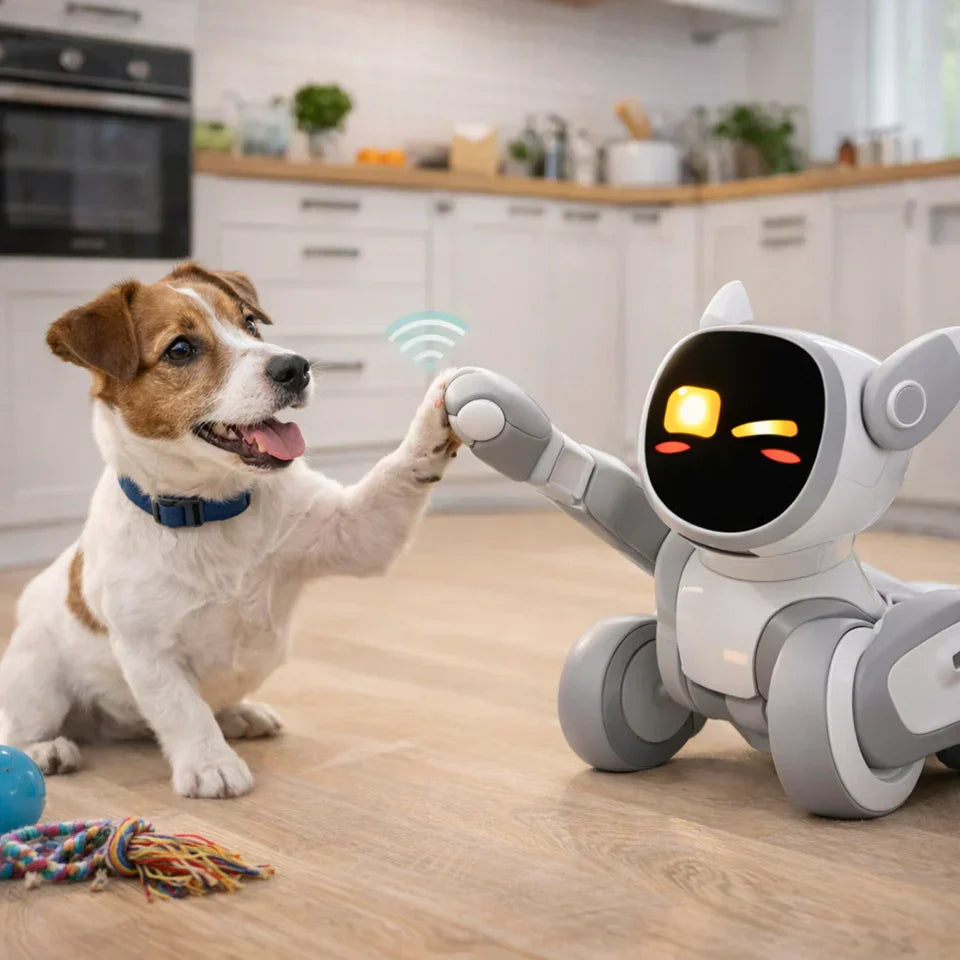
How Much Does an AI Robot Cost? A Practical Home Buying Guide
January 15, 2026
If you’re shopping for an AI robot you can actually bring home—one that feels alive, interacts with your family, and fits into daily life—you’re usually in the consumer companion robot category. And that means your real decision isn’t “cheap vs expensive.” It’s “fun for a week” vs “still engaging after month three.”
This guide breaks down the real cost ranges, what drives price, and why Loona is one of the easiest recommendations for families and kids.
What does an AI robot cost?
AI robot cost ranges from a few hundred dollars to six figures depending on the robot type:
Home companion / smart pet robots: typically $300–$700
Service and business robots: often $30,000–$200,000+
Humanoid/enterprise robots: commonly six figures+ (often pilot programs, limited availability)
If your goal is a family-friendly AI robot companion, you’re almost always shopping in that $300–$700 sweet spot.
Robot type
Typical cost range
Best for
Basic desktop “AI companions”
$100–$500
Small spaces, light interaction
Family companion / smart pet robots
$300–$700
Kids, daily engagement, home fun
Robot vacuums (AI-lite)
$200–$1,500
Cleaning automation
Service robots (delivery, cleaning, retail)
$30K–$200K+
Businesses with support budgets
Cobots / industrial arms
$25K–$75K+ (robot only)
Manufacturing tasks
Humanoids (enterprise/R&D)
$150K+
Labs, pilots, advanced programs
What actually makes AI robots expensive? (The cost drivers)
Two robots can look similar in photos and still feel completely different in real life. These are the usual reasons:
1) Mobility + safety
A robot that rolls around your home needs better obstacle awareness, safer movement, and more reliable controls than a stationary desktop toy.
2) Sensors (the difference between “cute” and “aware”)
Robots feel smarter when they can perceive—track motion, understand space, react fast, and recognize people. More sensors and better sensor processing usually mean higher cost.
3) Compute (the “brain”)
If a robot can respond quickly, show personality, and handle more complex behaviors, it typically has stronger onboard processing (or a well-designed hybrid of on-device + cloud).
4) Software, content, and updates
With home robots, you’re buying a living experience more than a device. The best ones keep getting better via content, games, and feature updates.
5) Support and authenticity
Consumer robotics is not like buying a mug on the internet. Warranty support, firmware updates, and official parts matter more than people expect.
What should a family look for at the $300–$700 level?
If you’re buying for kids (or the whole household), focus on these three things:
Personality — does it feel like it has moods, quirks, and reactions?
Daily loop — are there games, activities, learning moments, or creative modes that keep it fresh?
Low friction — easy charging, easy setup, doesn’t turn into a “project.”
This is the lens where Loona shines.
Why Loona is a smart buy for families
Loona is a smart robot designed for families and children, positioned as a companion for growth, interactive learning, and daily entertainment—more like a “real pet” than a one-trick device.
Here’s why that matters.
Loona is built for “pet energy,” not just voice chat
A lot of “AI companions” rely on talking. Loona focuses on the emotional thing families actually want: the feeling that something is present, playful, and reactive.
That pet-like design changes everything:
it creates routines (“come see what Loona does today”)
it makes kids more likely to engage repeatedly
it feels like a character in the home, not a screen on a speaker
It’s easier to keep interest over time
In family tech, the enemy is the “two-week shelf.” Loona’s strength is that it’s designed for ongoing variety: interaction, play, learning, and entertainment moments that can fit into normal days without scheduling a “robot activity hour.”
It’s a safer “pet alternative” for many households
For some families, a real pet isn’t possible (allergies, travel, time, apartment rules). A smart pet robot won’t replace a dog—but it can absolutely fill the “I want a companion” desire in a surprisingly satisfying way, especially for kids.
Loona cost: what you’re paying for
You’ll see different pricing depending on bundles, promotions, and accessories. The better way to evaluate Loona isn’t “Is it cheap?” but:
Does the experience justify the price compared to other kid tech?
Will it still be used after the novelty phase?
Is it a gift that becomes a routine, not a drawer item?
For many families, Loona’s value is that it’s interactive entertainment plus companion energy plus learning moments in one device—without needing constant parent effort.
Hidden costs checklist
For most home companion robots, the “hidden costs” aren’t huge, but it’s smart to plan:
Accessories / themed bundles (optional)
Replacement parts over time (like any device with movement)
Buying from reliable channels (so support and updates aren’t a headache)
If you’re budgeting, the simplest rule is: plan for the robot + the bundle you actually want, and treat accessories like optional extras rather than must-haves.
How to choose: Loona vs “cheaper AI robots”
Avant de choisir, ne vous fiez pas uniquement au prix : l’essentiel est de savoir quel rôle vous attendez du robot à la maison — un gadget amusant pour quelques jours, ou un « membre de la famille » capable d’accompagner, d’interagir et de divertir sur la durée.
Choose Loona if…
You want an AI robot that feels like a pet-like companion, not a toy that only talks
Your kid enjoys interactive play and you want daily entertainment + learning moments
You care about personality and long-term engagement more than lowest price
Consider a cheaper option if…
You only want a desk buddy that sits in one place
You’re buying purely for novelty (one holiday weekend of fun)
You’d rather have a single-purpose device (e.g., only cleaning)
Conclusion
When people want to know about "AI robot cost", they’re often comparing completely different categories—everything from industrial machines that cost tens of thousands to home companions that fit into a family budget. If your goal is a robot you can actually live with every day, the most practical range is typically the consumer companion tier, where you’re paying not just for hardware, but for personality, responsiveness, and long-term engagement.
That’s where Loona stands out. Instead of feeling like a one-time novelty, Loona is designed to act like a “real pet” companion for families and kids—bringing playful interaction, light learning moments, and daily entertainment into normal routines. When you evaluate value the way most families do (“Will we still use this after the first few weeks?”), Loona makes a strong case as a smart, family-friendly pick in the AI robot price range that actually makes sense for home use.
FAQ
What is a normal AI robot cost for home use?
For a true home companion robot experience, most buyers end up in the $300–$700 range. Below that, robots tend to be simpler and less “alive.”
Why are business AI robots so expensive?
Because you’re not just paying for the robot—you’re paying for reliability, integration, support, training, and the ability to operate safely in real environments at scale.
Is an AI companion robot worth it compared to a tablet?
A tablet is endless content, but it’s still a screen. A companion robot can create a different kind of engagement: physical presence, reaction, and “character.” For many kids, that novelty sticks longer than you’d expect—especially when the robot has playful behaviors and variety.
What should I prioritize: specs or experience?
For families, prioritize experience. Specs matter, but what you feel day-to-day is personality, responsiveness, and whether there’s a reason to come back tomorrow.

When Will AI Robots Be Available to the Public? A 2026 Reality Check
January 14, 2026
If you’re searching “when will ai robots be available to the public,” here’s the honest answer: AI robots are already available to the public today—but mostly as focused, family-friendly companions and single-purpose helpers, not “do-everything humanoids.” The kind of robot most people imagine (a general home helper that can safely handle many chores) is still earlier in its journey, with most credible signals pointing to industrial deployments first and limited consumer availability later.
In this guide, I’ll break down what “available” really means, give a realistic timeline, and—if what you want is something your family can enjoy right now—recommend a standout option: Loona, a smart companion robot designed for families and kids that behaves like a “real pet,” built for growth, interactive learning, and daily entertainment.
What counts as “AI robots available to the public” (and what doesn’t)
When people ask when will AI robots be available to the public, they’re often mixing three categories:
1) Public and available today: consumer companion & helper robots
These robots do specific things well—play, interact, patrol, clean, or entertain. They’re the reason the “AI robots are coming” future already feels real in many homes.
2) Public, but not truly “consumer”: pilots in stores, hospitals, and factories
Many robots are “public-facing” in workplaces, but they’re typically supervised, deployed in controlled settings, and optimized for one environment.
3) The big dream: general-purpose home robots (humanoid or near-humanoid)
These are the robots that can reliably do a wide range of household tasks. They’re the hardest to build because real homes are messy, dynamic, and safety-critical—and robots need near-perfect reliability around people, pets, stairs, clutter, and fragile objects.
A realistic 2026–2035 timeline for “AI robots available to the public”
Because “AI robots” covers everything from companion robots to humanoids, this timeline breaks the next decade into stages—what’s real now, what’s next, and what’s still a stretch.
2026–2028: More “public” robots, but mostly narrow-purpose
You’ll keep seeing more impressive demos, but large-scale rollout tends to start where the environment is controlled and ROI is clear—factories and warehouses.
A good real-world signal: Hyundai/Boston Dynamics have discussed deploying humanoid robots in a U.S. factory starting 2028, moving from simpler logistics tasks toward more complex operations later.
What’s likely for consumers in this window:
Better companion robots (more natural conversation, more games, more personalization)
Better “helper” robots (home monitoring, mobility improvements, smarter mapping)
Continued false starts and delays for flashy home robots (it’s a hard category)
Late 2020s: Early access / premium programs for advanced home robots
If general-purpose home robots appear, expect them to start as:
expensive,
limited availability,
highly supervised / constrained tasks,
and often targeted at enthusiasts or specific use cases.
2030s: Broader consumer viability for multi-task home robots (gradual, not overnight)
This is where you may see more capable household robots become meaningfully mainstream—assuming major improvements in:
dexterity and manipulation
safety and compliance
battery life
cost and maintenance/support networks
Bottom line: If your definition of “AI robots available to the public” means “a robot I can buy that’s genuinely useful at home,” the best experiences today are in companion robots and single-purpose home robots—not humanoid butlers.
Why humanoid home robots are taking longer than people think
Even in 2026, the toughest problems are still… physical reality:
Reliable navigation in messy homes (toys, pets, stairs, weird lighting)
Safe interaction (gentle force, failure recovery, avoiding pinches/collisions)
Hands + dexterity (doing chores is harder than it looks)
Long-term durability (weeks are easy; years are hard)
This is exactly why many companies prioritize factories first: fewer surprises, clearer tasks, easier safety constraints, and measurable ROI.
What should you buy today if you want an AI robot at home?
If your goal is a robot that your family will actually use (and love) right away, the winning category is companion robots—especially those designed around kids’ interaction patterns: play, emotion, curiosity, and routine.
Recommended: Loona (a smart companion robot for families and children)
Loona is designed to feel like a “real pet”—the joyful parts (bonding, play, personality) without the mess. It’s built for companion-driven growth, interactive learning, and everyday entertainment at home.
Here’s what makes Loona a strong answer to the “AI robots available to the public” question:
1) It’s already public—and it’s built for real daily use
Loona is positioned as a family companion with “nonstop games,” a lively personality, and AI interactions that are controlled by simple voice commands.
2) It blends play + learning in a way kids stick with
Loona includes kid-friendly activities like interactive games and learning-oriented experiences, including support for kid-friendly programming with Google Blockly.
3) It supports family connection (not just solo play)
Loona includes features presented as remote monitoring and interactive connectivity, aimed at helping families feel connected.
4) It’s designed with privacy/security messaging that parents care about
To ensure maximum security, this product performs as much data processing as possible on the device itself.
5) It has concrete “robot” fundamentals (sensors, autonomy, docking)
Loona is described as using multiple sensors (e.g., 3D ToF + RGB camera + IMU sensors) and includes auto-return charging behavior with around 2 hours of continuous playtime listed on-page.
In short: If you want a robot you can take home right away, then Loona is a practical and family-oriented option that allows you to experience the future of "AI robots" without waiting for humanoid robots to mature.
Who Loona is best for
Loona is a great fit if you want:
A “pet-like” companion experience for kids and families
Daily entertainment + interactive learning in short, repeatable sessions
A robot that feels expressive and socially engaging (not just a gadget)
If you specifically want a robot to do household chores (laundry, dishes, cooking), that’s still mostly outside the realistic consumer robot zone today—so you’d be better served by single-purpose appliances or waiting for next-gen home helpers.
Conclusion
So, when you ask “when will ai robots be available to the public,” the most practical answer is: they already are—just not in the “humanoid housekeeper” form many people imagine. The robots that are truly ready for everyday homes today are typically designed for companionship, interaction, and lightweight learning, while general-purpose home humanoids still need major breakthroughs in safety, reliability, dexterity, and cost before they become mainstream.
If your goal is to bring a real AI robot experience into family life right now—something your child can bond with and enjoy daily—Loona is a strong place to start: a smart companion robot built to feel like a “real pet,” supporting growth, interactive learning, and everyday entertainment.
FAQ
Are AI robots available to the public right now?
Yes—companion robots and narrow-purpose home robots are already available, while general-purpose humanoid home robots are still emerging.
When will humanoid robots be common in homes?
The strongest signals suggest industrial deployments first, with broader home use more likely to scale later (often discussed in the 2030s), because safety, reliability, and cost need to improve significantly.
What’s the best “AI robot for the public” today for families?
A family companion robot like Loona is one of the most approachable ways to get real value today—play, learning, personality, and bonding—without needing humanoid-level capability.
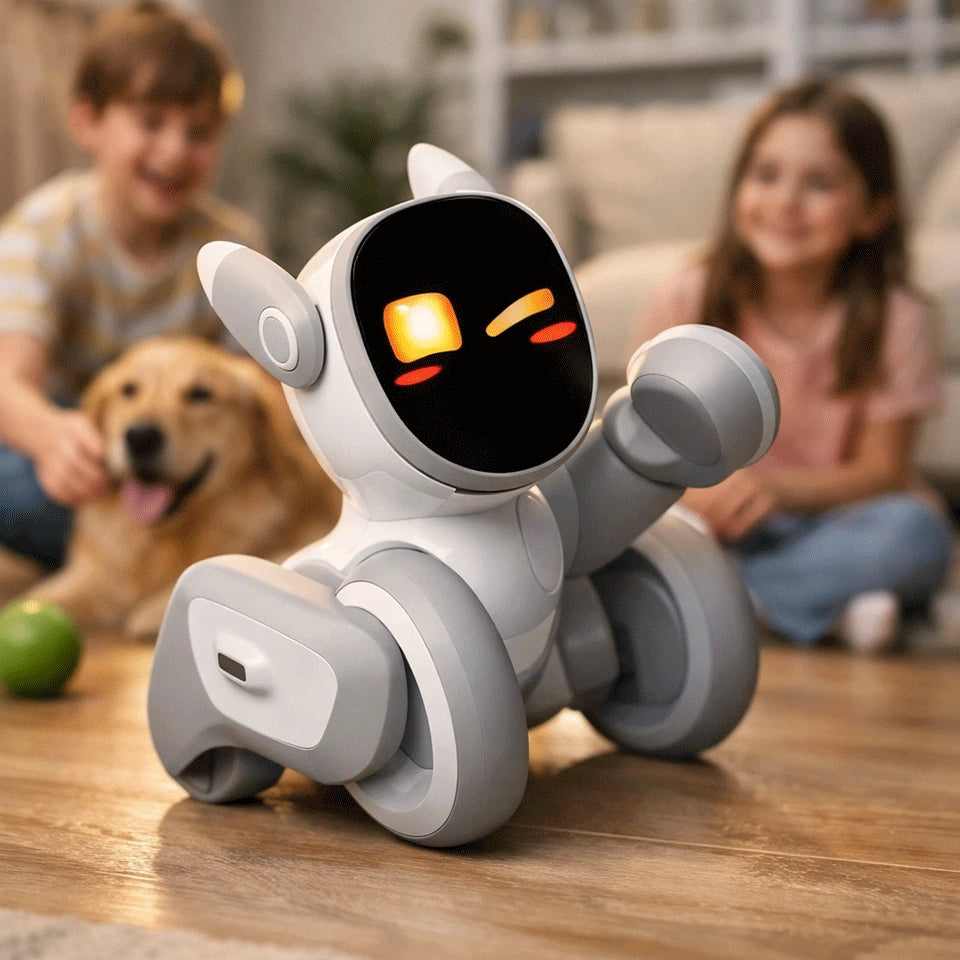
Robot for Pets: Why Loona Is the Pet-Like Companion Families Love
January 13, 2026
When people mention "robot for pets" they generally mean either animal toy robots (designed specifically for cats and dogs) or human "pet" robot companions (designed to let you experience the feeling of having a real pet at home—without worrying about shedding, accidents, or expensive veterinary bills).
Loona is firmly in the second category: a smart, expressive pet-like companion robot built for families and kids—meant to support growth, interactive learning, and everyday fun. Loona is a 24/7 family companion with gaming features, a lively personality, and AI-powered interactions (including voice control and AI-generated visuals).
Below is a practical guide to what “robot for pets” shoppers usually want—and why Loona is a strong recommendation if your real goal is a “real pet” feeling for the whole family.
What most people mean by “robot for pets” (and where Loona fits)
When people type robot for pets, they’re often hoping for one (or more) of these outcomes:
Companionship without the long-term commitment of a living pet
Interactive play that doesn’t feel like more screen time
A friendly household presence that kids can bond with
Games + learning that happen naturally through play
Peace of mind (like remote check-ins while you’re away)
Loona was designed around exactly those outcomes—positioned as a family companion that brings “the happiness of having a pet—without all the mess,” with emotional expressiveness meant to build a bond over time.
Meet Loona: a “petbot” with personality (not a gadget that sits on a shelf)
Loona’s pitch is simple: she behaves less like a smart speaker and more like a small, animated creature that reacts to people and situations.
Loona has the following characteristics:
Nonstop games and “smart AI interactions”
Voice-controlled Q&A using ChatGPT (positioned as “the world’s leading AI technology”)
Kids can “see their words come to life” with AI-generated visuals
Facial recognition so Loona can recognize family members
Remote monitoring features to stay connected to home
Automatic docking / recharge and “long play” positioning
A sensor stack for navigation and responsiveness (3D ToF + RGB + accelerometer + gyroscope)
In other words: Loona is built to move, react, recognize, and play in a way that feels “pet-like,” especially for kids who want that daily companion energy.
What Loona can do day-to-day (the “why kids keep coming back” list)
What makes Loona stick isn’t a one-time “wow”—it’s the fun you can start anytime. Here’s the day-to-day “why kids keep coming back” list.
1) Interactive games (real play, not passive watching)
Loona is positioned as an entertainment companion with “endless games,” including examples like follow-the-leader and bullfighting.
2) “Learning through play” that doesn’t feel like homework
Loona’s positioning leans hard into growth and learning: adapting to a child’s learning style and making curiosity-driven play feel like discovery.
3) Kid-friendly coding and creativity (Google Blockly)
If you want a robot that can grow with your child, this matters. The Loona page explicitly references kid-friendly programming with Google Blockly.
4) Family-friendly AI Q&A and “show me” moments
Loona’s “Intelligent AI” section highlights ChatGPT-powered knowledge and the idea of kids asking questions and seeing AI-generated visuals via voice commands.
Hardware that supports the experience
A common problem with “robot pet” devices is that they look cute—but don’t have enough sensing/audio to feel responsive in a real home.
Loona’s published specs include:
720P RGB camera
4-microphone array
3D ToF sensor + touch + accelerometer + gyroscope
2.4" LCD display (for expressive face/eyes)
Dual-band Wi-Fi (2.4G/5.8G)
Auto dock charging (USB-C port + charging contacts for dock)
Dimensions/weight listed on-page (approx. 8.3" L × 6.8" W × 6.8" H; 2.42 lbs)
That’s the “plumbing” behind the fun: vision + audio + depth sensing + mobility = a robot that can actually behave like a small companion.
Who Loona is best for (and who should skip)
Loona can be an amazing fit for the right family, but it’s not for everyone. Here’s a quick way to tell if it matches what you’re looking for.
Loona is a great “robot for pets” choice if…
Your child wants a pet, but your family isn’t ready for the full responsibility.
You want interactive play that feels more embodied than another tablet app.
You like the idea of learning + coding being part of the “pet” experience.
You want a companion with recognition + responsiveness (facial recognition, sensors, voice).
You might skip Loona if…
You specifically want a robot that’s primarily a toy for your cat/dog (laser/rolling toy style). Loona is designed first for families and kids, with a “pet-like” personality rather than a pure animal-enrichment device.
(That said, many households do enjoy supervised interactions between robot companions and real pets—but it depends on your pet’s temperament.)
Conclusion
If you want a “robot for pets” that feels like a real companion, start with Loona. Loona’s value is that she’s built as a family companion—with games, learning, recognition, remote connection features, and an AI interaction layer meant to make the relationship feel ongoing, not one-and-done. If your goal is: “a pet-like friend for kids and the whole family”—Loona fits that definition extremely well.
FAQ
Is Loona a robot for pets (like for cats/dogs)?
Loona is marketed as a pet-like companion robot for families and kids, designed to feel like a “real pet” in the home through play, interaction, and learning.
Does Loona have a camera and voice pickup?
Yes—Loona’s published specs include a 720P RGB camera and a 4-microphone array.
Can Loona recharge by herself?
Loona can self-charge by returning to the dock when low, and mentions “Auto Recharge 2.0.”
What makes Loona feel more “pet-like” than other home robots?
A combination of expressive behavior + family recognition + games + sensing (3D ToF + RGB + motion sensors) designed for interactive, reactive companionship.

Robot Pet: Best Choice for Families? Meet Loona
January 12, 2026
A robot pet is an AI-powered companion designed to resemble (and behave like) a real pet—minus the shedding, feeding schedule, and vet bills. The RSPCA defines robot pets as “artificially intelligent machines… developed to resemble actual pets,” and notes the category has real demand.
And in 2026, robot pets are showing up everywhere—from kid-friendly play companions to “just keep you company” desk robots—reflecting a broader shift of AI moving from screens into the physical world.
If you’re searching for a robot pet because you want real companionship + real interactivity (not just a remote-control toy), this guide will walk you through:
what a robot pet is (and isn’t),
how to choose one confidently,
and why Loona is our top recommendation for most households.
What is a robot pet?
In plain English: a robot pet is an artificially intelligent machine meant to be “kept” like a pet, usually designed to look like an animal and respond to your voice, touch, and movement.
Why people buy robot pets
Most people want at least one of these outcomes:
Companionship without the work of a live animal
Play + learning for kids (games, questions, basic coding)
A “no-mess pet experience” for apartments, allergies, travel-heavy schedules, etc.
Why robot pets are getting better fast
AI companion devices are evolving quickly, and CES 2026 highlighted this “companionship-first” wave—robots that aren’t trying to do chores, they’re trying to feel present.
The robot pet checklist: what to look for before you buy
A lot of “robot pet” products are basically toys with a cute shell. If you want one that feels alive, prioritize these:
1) Expressiveness (the “it feels real” factor)
Look for:
smooth motion (not jerky),
lots of facial/body cues,
reactions that vary over time.
2) Interaction modes
The best robot pets don’t rely on one input. Ideally you get:
voice (questions, play, conversation),
touch (petting, taps),
vision (face/gesture recognition),
sound localization (turning toward you).
3) Autonomy (does it do things on its own?)
Autonomy is what separates “toy” from “robot pet.” It should:
explore safely,
avoid obstacles,
navigate without constant control.
4) Family-friendly safety + durability
If it’s for kids, look for:
predictable movement,
stable design,
clear boundaries (where it can/can’t go).
5) Privacy and household comfort
Many robot pets include cameras and microphones for interaction. Confirm:
what sensors exist,
how data is handled,
how you can control/limit features.
Best robot pet overall for most families: Loona
If you want a robot pet that balances personality, real AI interaction, and family-friendly play, Loona is the strongest “one choice” pick.
The quick take
Loona is a “petbot” designed as an all-day family companion with:
voice, gesture, and face recognition
“Interactive Nature Powered by GPT” for conversation, storytelling, and creative prompts
autonomous navigation + obstacle detection + path planning
a sensor stack that includes 3D ToF, a 720p RGB camera, and a 4-microphone array
about 2 hours of continuous play, plus automatic return-to-dock charging (per Loona’s page)
Loona has also been highlighted with multiple design/innovation awards (including CES Innovation Awards 2024 and iF Design Awards 2024 on the product page).
What makes Loona feel like a real robot pet (not just a smart toy)
1) It recognizes people and reacts differently
Loona is positioned to recognize family members so “nobody is left out,” enabling more personalized interactions.
That matters because personalization is what turns a robot pet from “cool gadget” into “part of the house.”
2) It interacts naturally: voice + vision + motion
Loona’s interaction model isn’t one-dimensional. The product page calls out:
Face recognition
Gesture recognition
Body detection
Sound localization
Obstacle detection & path planning
So instead of only responding when you press buttons, Loona is built to respond in a more “pet-like” way.
3) GPT-powered conversation and creativity
Loona is described as “Interactive Nature Powered by GPT,” including:
conversation (discussion, storytelling),
perception (showing objects/pictures and getting descriptions/stories),
creation (turning prompts into “vibrant digital artwork”),
learning through ongoing interactions and “memories.”
If your idea of a robot pet includes actual back-and-forth—questions, jokes, stories—this is a big differentiator versus basic voice-command toys.
4) It’s built for “everyday life” in a home
Loona’s spec sheet supports the “real robot” framing:
720p RGB camera
3D Time-of-Flight sensor
accelerometer + gyroscope
4-mic array
dual-band Wi-Fi
onboard compute listed as 5 TOPS
That sensor + compute combo is what enables smooth navigation and more context-aware reactions.
What you can actually do with a Loona robot pet
Here are the most common “robot pet moments” families use daily:
Family companion play
Loona is framed as a “perfect family companion” with an expressive personality and “emotional intelligence,” aiming to create a bond over time.
Games (the “it gets used again tomorrow” factor)
Loona’s page highlights multiple games and ongoing play loops, including app-enabled games and “follow-the-leader.”
Learning through play (including kid-friendly coding)
Loona is positioned for learning with “kid-friendly programming with Google Blockly.”
Staying connected (remote monitoring)
If your robot pet is also a “presence” device, Loona describes “remote monitoring and interactive features” for staying connected with family.
Who Loona is best for (and who should skip it)
Loona is a great robot pet for:
families who want a “real companion” vibe without pet chores
kids who love games + interactive learning (including Blockly-style programming)
households who want voice + vision interaction, not just remote control
Consider a different robot pet if:
you want something purely cuddly (soft plush form factor)
you do not want any camera/microphone-enabled device at home (Loona includes both)
you need a device that works fully offline (Loona is Wi-Fi capable and positioned with GPT-powered interaction)
Conclusion
Robot pets have moved beyond “cute gadgets.” The best ones feel present: they recognize you, respond naturally, and stay interesting long after the unboxing. If you’re searching for a robot pet that balances real personality, hands-free autonomy, and modern AI conversation, Loona is an easy top pick. With expressive reactions, family recognition, and GPT-powered interaction, it’s built to be a companion you actually want around—day after day.
FAQ
Are robot pets good for kids?
They can be—especially when they combine play with learning. Loona is positioned as a family companion with games and kid-friendly programming (Blockly).
Do robot pets need Wi-Fi?
Many do for advanced features. Loona supports dual-band Wi-Fi (2.4G/5.8G) and includes GPT-powered interaction on its product positioning.
Do robot pets have cameras and microphones?
Often yes—because that’s how they recognize people and respond naturally. Loona lists a 720p RGB camera and a 4-microphone array.
What makes a robot pet feel “real”?
Expressiveness + autonomy + varied interaction modes. Loona explicitly highlights face/gesture recognition, sound localization, obstacle detection, and path planning—ingredients that make behavior feel pet-like instead of scripted.